AI Search Data Is Here: Educational Content Is Winning.
 AUTHOR:
Capacity
AUTHOR:
Capacity
Publishing more videos won’t fix a YouTube strategy that isn’t grounded in how people find, choose, and watch videos.
A stronger approach starts with understanding the channel you already have. By looking at search visibility, audience behavior, content performance, titles, thumbnails, and the competitive landscape together, you can see where your YouTube strategy is working and where there’s room to improve.
That matters because YouTube SEO goes well beyond adding keywords to a title. YouTube says its search system considers three primary factors: relevance, engagement, and quality. Relevance includes how well a video’s title, description, tags, and content match a search. Engagement signals, including watch time for a particular query, also help YouTube determine whether a result is useful to viewers.
In other words, optimization can help people find your video—and the video still has to earn their attention.
Here’s how we approach a YouTube analysis and the practices arts organizations can use to build a stronger strategy.
Before changing titles or developing a new content calendar, look at how people currently reach the channel.
YouTube Analytics breaks traffic into sources such as YouTube Search, Suggested Videos, Browse Features, external sites, and other discovery paths. The Reach tab also shows the specific search terms people use to find individual videos.
Those search terms are especially useful because they show where audience demand and your existing videos already overlap.
Look for patterns:
This gives you a baseline. Instead of building an SEO strategy around assumptions about what people might search for, you can start with evidence about how viewers already discover your content.
Individual keyword rankings matter, but a strong YouTube strategy shouldn’t become a collection of disconnected keyword targets.
Look at the broader subjects behind your best-performing videos.
If multiple videos attract viewers around a related set of questions, that can signal an opportunity to build deeper coverage around the topic.
This is where YouTube SEO and creative strategy start to reinforce each other.
YouTube says quality signals help its systems identify channels that demonstrate expertise, authoritativeness, and trustworthiness on a topic. A connected library of useful content can give viewers more reasons to continue watching while creating more ways for the channel to address relevant searches.
The goal is to own your subject matter well enough to answer the different questions people have about it (not to make multiple versions of a similar video).
Keyword research is very useful on YouTube, and it’s just one input.
YouTube recommends identifying one or two primary words or phrases that describe a video and incorporating them prominently in the title and description. Its own guidance points creators to YouTube Analytics research insights and keyword tools to understand what audiences are looking for.
Start by comparing several sources:
That last step matters. A high-volume keyword isn’t automatically a good topic. The best opportunities sit at the intersection of audience interest, relevance to your organization, and your team’s ability to make a genuinely useful video.
A YouTube title has two jobs: help the right audience understand what the video covers and give them a reason to choose it.
A title built mainly around an internal campaign name, webinar series, guest name, or clever phrase may make perfect sense to the organization publishing it. It can mean very little to someone searching YouTube for an answer.
Lead with the subject viewers care about. Branding and series information can come later when needed.
Video descriptions provide another opportunity to establish what the video covers and help YouTube connect it with relevant searches.
The first few lines carry extra weight for the viewer because they appear before someone expands the full description. YouTube recommends using that space to explain the video and incorporating the primary terms that describe the content naturally.
A useful description should quickly tell someone:
From there, you can add supporting information, related resources, links, chapters, and other channel details where appropriate.
Avoid turning the description into a wall of repeated keywords. Good YouTube SEO should make the content clearer, not harder to read.
Tags are one of the most persistent sources of YouTube SEO advice, but they shouldn’t be the center of your optimization strategy.
YouTube says a video’s title, thumbnail, and description are more important for discovery than tags. Tags can still help, particularly when terms are commonly misspelled, but they play a limited role compared with stronger metadata and content.
Ranking in search doesn’t accomplish much if viewers don’t choose the video (and getting the click doesn’t accomplish much if they immediately leave).
That makes thumbnails and audience retention part of the SEO conversation.
YouTube says 90% of its best-performing videos use custom thumbnails.
It also recommends evaluating titles and thumbnails together and using Analytics to understand which approaches resonate with an audience.
Then, the audience retention report shows which parts of a video hold viewers’ attention and where people drop off. That can reveal issues no keyword tool will find: introductions that take too long, titles that promise something the video doesn’t deliver quickly enough, or formats that consistently keep people watching.
This is one reason YouTube SEO shouldn’t sit apart from video production. Search intent should influence the video itself.
A YouTube strategy doesn’t always need to start with the next video.
Older videos may already cover topics people are searching for but have titles or descriptions that make those topics difficult to identify. Other videos may still be useful but have thumbnails that no longer compete effectively for attention.
YouTube recommends experimenting with updates to older thumbnails, and creators can use Studio data to evaluate title and thumbnail performance over time.
That makes content optimization an ongoing process.
During a channel analysis, separate existing videos into practical groups:
This turns the audit into an action plan rather than a report that gets filed away.
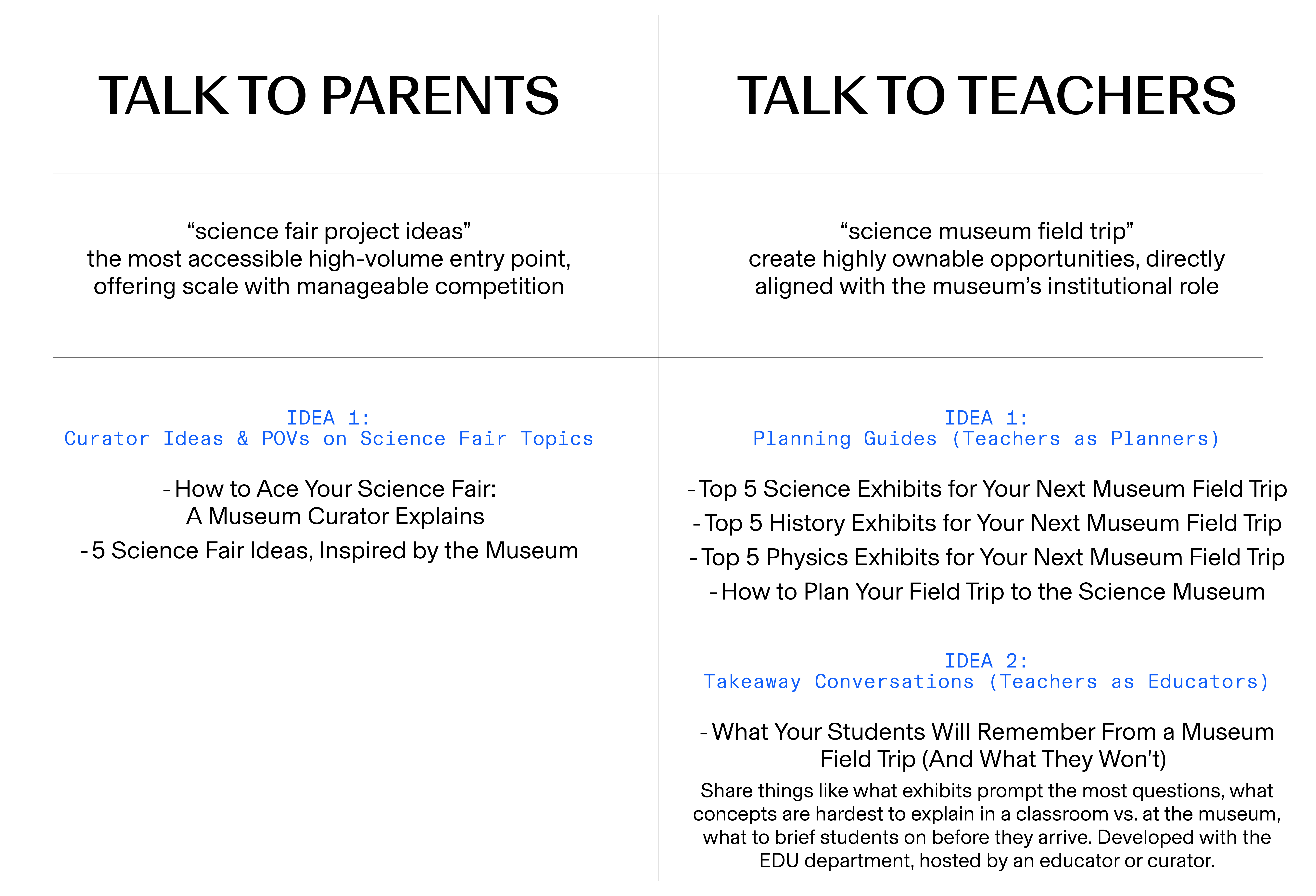
One channel we analyzed had a recurring video series built around science content for families. The concept was strong: useful, approachable videos designed to make science more accessible to parents and kids. Moreover, we were able to identify that this is a large, active audience (YouTube Trends signals for science experiments and science fair ranked among the strongest in the relevant dataset, confirming sustained demand).
We developed optimized creative production ideas around two primary audiences: parents and teachers.
The biggest opportunity in a YouTube analysis usually isn’t one keyword, metadata field, or isolated optimization.
It’s the chance to connect audience demand with the entire content process.
Search data can help identify what people want to know. Titles and thumbnails can make the value clear. Strong videos can deliver on that promise.
Analytics can show what worked. Then those insights can inform the next round of videos.
Used well, a YouTube SEO strategy becomes a feedback loop: learn how your audience searches, create videos that meet that need, measure how viewers respond, and use what you learn to make the next video stronger.
If you’re wondering where to get started with YouTube SEO, Capacity can help! Our SEO/AEO team would love to chat.