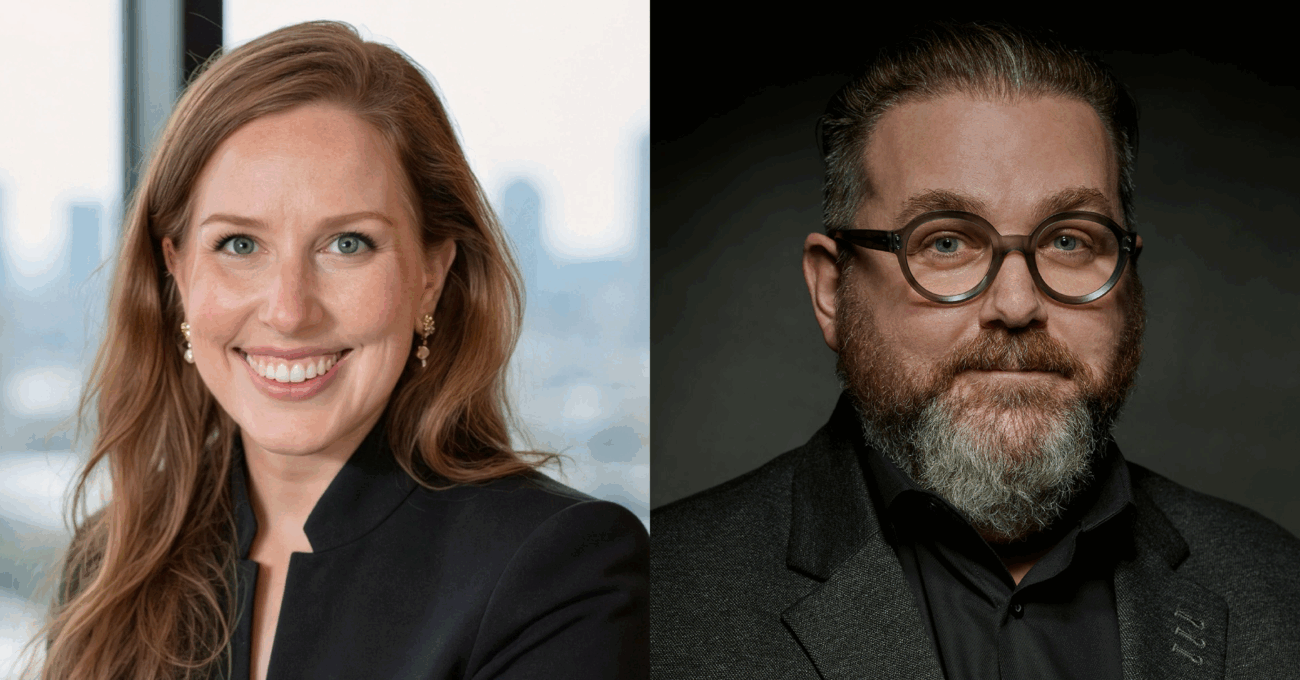

Join host Monica Holt as she reflects on the moments that defined the Fall 2025 season, and hear cultural leaders remind us why connection, creativity, and collaboration are more important than ever.
Attract and engage your patrons with a fully-managed ad strategy across all your platforms.
We'll help your organization use AI to save time and spark creativity while staying grounded in your values.
Your creative assets + our impeccable execution = thumb-stopping social content.
Let's harness your website’s data and uncover opportunities to optimize and grow.
We’ll partner on a strategy to level up your email program and help your ROI shine.
Ensure visibility across the search landscape with a technically sound website and content that deserves to rank #1
Meet the President and CEO of Werklund Centre
This episode is hosted by Monica Holt.
For Alex Sarian, relevance isn’t a buzzword. It’s a mandate for the future of the arts.
As President and CEO of Werklund Centre in Calgary, he’s leading the largest cultural infrastructure project in Canadian history, a transformation that will soon make the organization the country’s largest performing arts campus. But Alex is quick to point out that bricks and mortar aren’t the real story. The deeper shift is philosophical: a move away from mission statements as fixed declarations and toward a practice of asking, “What does the world need right now that we are uniquely positioned to do?”
In this episode, Alex reflects on the evolution underway at Werklund Centre and the ideas behind his best-selling book The Audacity of Relevance. He offers a roadmap for leaders ready to create with their community—not for them—and makes a compelling case for why relevance is the most powerful strategy we have for building a sustainable, future-facing cultural sector.
Monica Holt: Welcome back to CI to Eye. I’m Monica Holt. Today’s conversation is with Alex Sarian, President and CEO of the Werklund Centre in Calgary, formerly Arts Common. He’s also the author of the Audacity of Relevance. Alex is shepherding one of the most ambitious cultural infrastructure projects in Canadian history—a nearly $700 million expansion that will create the largest performing arts campus in the country. But Alex will tell you that anyone with enough money can build a building. The real question is whether people will care when you cut the ribbon. So instead of leading with construction plans, he led with a fundamental re-imagining of what a performing arts center could be, not just for the artists, but for the entire city trying to reinvent itself. The result? A project that convinced city government this wasn’t a cultural investment, but a city building imperative. As we discuss this large project in Calgary, we also talk about why donor fatigue might actually be fatigue with us, why programming in a vacuum becomes a business liability, and how the humility Alex learned as a theater educator transformed his approach to institutional leadership. If you’re feeling paralyzed by some of the biggest questions facing arts organizations today, this conversation offers a path forward. Let’s dive in.
Alex Sarian, thank you so much for joining us on CI to Eye today. I am so glad to be talking to you.
Alex Sarian: Thanks for having me, Monica. I’m excited.
Monica Holt: We love to start every episode kind of getting a little bit of your story and really what first drew you into the arts. Do you have a defining moment as a kid where you knew the arts were for you?
Alex Sarian: There is a story that I am very embarrassed to be sharing. So I’m originally Canadian and when I was a very young kid, I want to say like five or six, my parents took me to go see Phantom of the Opera in Toronto before it made the move to Broadway.
And I remember at the very end my parents turned to me and said, what was your favorite part? And I said to them, straight face, I said, the curtain call. And they thought I was developing a really weird sense of humor as a young person, but when they asked again and probed, I was like, the fact that the Phantom came out on stage and his face was okay and his face was normal, the fact that these performers had put on a play and had put on a story that blew my mind as a young person, the idea that stories could take us on that journey and the fact that stories could trick us in a way was this really powerful experience that I felt as a young audience member. And in hindsight, so much of it makes sense in terms of my passion for young audiences and education. And so that was it. That was it.
Monica Holt: Well, glad to hear that. Listen, we have a strong love for Andrew Lloyd Weber everything on this podcast these days. So speaking of your childhood, your kind of trajectory growing up went across cultures and continents. As a young person, you’re experiencing a lot of different cultures as you were growing up in different places around the world. Can you talk a little bit about how that experience shaped you and how it maybe helps determine how you see yourself moving through the world now?
Alex Sarian: Yeah, no, I mean that’s a really important aspect of who I am and what I do. So I mentioned I was born in Canada, but I was raised in Argentina. So my entire, from the ages of three to 18, I grew up in Buenos Aires and between Argentina and Uruguay. And one of the things that really informed that experience for me was, culture is not something that you have to pay to play with in countries around the world. And certainly when you have a culture as strong as Argentinian culture and with music and tango and it’s just everywhere, it’s free… And growing up, I fell in love with the impact that the arts had on me as a young person. Actually, when I moved to New York, my original desire was to be a theater teacher and it was such a culture shock for me to go to New York for university and realize that a cultural mecca like New York City actually doesn’t have access to arts and culture the way that I grew up with, and felt so counterintuitive. So a lot of what I’ve been doing since is certainly building on my love of education and families and access, but it’s also been trying to counter that initial culture shock of saying, how is it possible that a city like this has such a strong paywall for participation in arts and culture? So that’s informed everything I’ve done since. Now obviously I say this having had the privilege of forming myself professionally in New York. Almost 20 years there is an incredible gift. But when I was at Lincoln Center, one of the things that I did a lot was I oversaw international consulting for a while and it was so humbling to wear that New York City hat or the Lincoln Center hat and then be going into different communities around the world and realizing firsthand that whatever worked in New York was not going to work in these communities. And realizing that what is success is so deeply hyper-local. And so I think that to me was a really a series of humbling experiences and ultimately it’s what opened the door for me to consider leaving New York City at some point.
Monica Holt: As you think back on the earlier parts of your career in New York, how did your background in arts education frame the way that you move through these larger institutional questions today?
Alex Sarian: So it does go back to education, and one of the things that I think about all the time — So any of us that have ever gone through sort of a training in education, whether it’s because we wanted to be a teacher or a teaching artist, the first thing that you’re taught is that if a young person is not learning, it is rarely their fault. And so the idea that if you are an educator or a teacher and you are trying to engage folks in a lesson or an experience, if they are not receiving the experience the way that you intended, you can’t blame them. And so that humility and that need for responsiveness to me was so inherent in my upbringing and in my professional training. When I went from the classroom into arts administration, I sort of carried that question with me and I said, well, okay, if the institution that’s trying to engage these young people isn’t succeeding, we can’t blame them.
We need to really take a hard look internally and say, what could we be doing differently? Because ultimately our success is defined by others. And that idea, which to me seems so obvious, I find shocking how at an institutional level, we somehow just shut ourselves off from our ability to measure our impact on others and our ability to engage with others. So that to me has always been what has brought me into these sort of offices and leadership roles is always this desire of saying, what does the world need right now that we are uniquely positioned to do as an arts organization and always reconcile our mission with what it is that others are telling us.
Monica Holt: It’s interesting, as you were talking about that, it reminds me in your book the Audacity of Relevance. One of the things you talk about very early on is this idea that their perception is our reality. Right? And I want to talk so much about the book in a minute, but before we get there, just as means of greater introduction, you are the President and CEO of the Werklund Centre, which is formerly Arts Common, in Calgary. For listeners who might not be as familiar, will you just give us a little background on what the Werklund Centre is, what makes it unique in Canada’s cultural landscape, and what you are looking forward to as you are in quite a moment of great transformation?
Alex Sarian: We certainly are. So Werklund Centre is a performing arts center in Calgary, sort of western Canada. We are the third largest arts center in the country, and we are home to a variety of really incredible organizations such as the Calgary Philharmonic Orchestra, and Theater Calgary, Alberta Theater Projects… We are home to One Yellow Rabbit and the High Performance Rodeo… Some of the most of amazing artists and arts organizations in this country. And one of the things that’s really exciting right now is that last December we broke ground on the largest cultural infrastructure project in Canadian history, just shy of $700 million. And by the time we’re done, we will be the largest performing arts campus in Canada, having roughly around 12 performance spaces, indoors, outdoors, across a million square feet. So it’s a pretty remarkable project and expansion story. I think it speaks to our city’s growth. I think it speaks to the repositioning of arts and culture in Canadian society. Really a lot of amazing questions are being asked, and we have the privilege of answering some of those through this construction project, which is certainly keeping me very busy.
Monica Holt: I would imagine more than a little busy. And you joined that organization, am I right, in May of 2020?
Alex Sarian: That’s right.
Monica Holt: I would think that in some ways embarking on an organization in a moment of international crisis and then shepherding this cultural infrastructure project that was coming on the tail of this global crisis, balancing all these things while being the new leader of the organization, I have to imagine took quite a bit of emotional fortitude in that moment.
Alex Sarian: You know what? It actually didn’t, and I don’t mean to underplay it, but when I moved here, the possibility or the desire or the ambition of this project had always been sort of bubbling under the surface. And I remember when I joined here, I said to my board who’s incredible, I said to my board, ‘Anybody with enough money can build a building. Physical transformation is not transformative.’ I said, ‘The real transformation is whether or not communities around us will care about it. When we cut the ribbon on this thing, will people come?’ And so that’s not a bricks and mortar exercise, that is a philosophical exercise, that is a programmatic exercise. And so as part of that, we said, what does it mean to be a civic institution that exercises its civic responsibility through the lens of arts and culture? And what’s interesting is that when we reshifted that mandate, there’s no greater clarity on what your civic responsibility is than when the world is falling apart.
And so for us, the devastation of COVID actually gave us an incredibly clear path as to what it is that we could do to make our city a better place, to make the world a better place. And yes, we were doing it through the lens of our mission statement, but it was always in service to something greater. When your mandate is civic and the world is falling apart, then there is not enough time in the day for you to do what you need to do. And yet, if you are an organization and all you do is embrace your artistic mandate, there are so many institutions that I respect and I admire that sort of took a backseat and said, well, the world’s falling apart. Our artistic mandate can really slow down a little bit because the world needs to get back up on its feet and then we’ll come back. And I was like, that was such a missed opportunity for so many arts organizations because if we don’t think that we are pivotal to the health of our communities, then why should our communities feel that way?
Monica Holt: Extremely well put. So even still, even as your organization had the clarity of purpose that it had about its engagement with community, getting your government partners, your private donors, your community groups, the wonderful resident companies you mentioned all on board with this shared vision for transformation of the Werklund Centre, that’s really complex and particularly in a time as you allude to where this global crisis is ongoing, how did you manage that moment of building consensus to move forward with all of the external partners?
Alex Sarian: So once we were able to articulate that value proposition and validate it with the communities that we were hoping to be in service to, we were then able to go to the city government and say, there is a need for a project like this not to be perceived only as a cultural project, but as a city building project. And downtown Calgary, like many other downtowns, were seeing very low foot traffic, very low economic impact. All of the Monday through Friday workers were obviously working from home. So there was this deep concern that downtown Calgary was going to be completely abandoned for decades. And the city — and city council, in its wisdom, actually said, ‘We’re going to put together this downtown revitalization strategy and put money behind it.’ And the strategy included everything from office to residential conversion incentives to tax incentives to funding for activations.
But one of the greatest investments they made as part of that strategy was cultural infrastructure because they recognized that when you invest in the infrastructure that people can come to, not only does it provide citizens a place to go, it also creates a ground zero for economic impact within the downtown core. So we were able to take this re-imagined value proposition that was very intentionally in service to the city of Calgary, and Calgary — who was searching for opportunities to reimagine itself — really latched onto it. And so it was never positioned as a cultural project, it was positioned as a city building project. This is about a city trying to redefine itself and using culture as a gathering place.
Monica Holt: That makes complete sense. And I think another really interesting point that you’ve made before, but that I’ll ask you to reiterate a bit here, is that organizations can hold a mission statement and a value proposition statement together. Those are two separate things that both need to live in the organization. Can you talk a little bit about what led you to this idea of holding these two statements together and what the difference is if someone wants to dive in and say, ‘Oh, that makes a lot of sense to me. How would I approach creating a value proposition that is different and can be held together with my mission statement?’
Alex Sarian: That’s a great question. So one of the things that I always ask myself and my team, and it’s a question that has taken years to craft, and it’s a fairly simple question… The question is, ‘What does the world need right now that we are uniquely positioned to do?’ And it seems like such a basic question, but when you study it, what you’re essentially asking is, can my mission statement be in service to something of incredible urgency? This question of what does the world need right now forces you to look beyond the walls of your institution. It actually also forces you to look beyond your own mission statement, to just have an awareness of what is happening in the world and to actually recommit to the world around you.
Monica Holt: That’s right. And so that really does bring us to the book itself. And I will just say if folks haven’t had a chance to read it, please do. It’ll get you thinking about what the role of arts and cultural organizations right now can be, should be, might become. You published the Audacity of Relevance last year. What was the moment or the experience that first made you think, ‘I need to write this book. I need to write some of this down.’
Alex Sarian: So at first it was the idea of the project. The world was gonna start noticing that this massive construction site was going to be growing, and I really wanted to prevent us from getting to a moment in time where all this was was just a shining new building. And so it was really important to me to put pen to paper and be able to articulate some of the stories that were happening behind the scenes. And as I mentioned earlier, anybody with enough money can build a building. The real question is whether or not people will care. And so the transformation is philosophical and programmatic, and then the building just becomes the physical manifestation of it all. But something else was happening during the pandemic that really sort of upped the sense of urgency for me. I’ll give you an example. In Canada, there was this wonderful article written in The Globe and Mail by a wonderful journalist named Josh O’Kane, and he had written this article about all of the reasons why it would become more challenging to run an arts organization post pandemic.
And he lists all of these really factual things like inflation and escalation and consumer behavior and philanthropic trends and all of these things that to be honest, and you and I both know this, are not new. These are things that have been predating the pandemic for decades. And I remember reading that article and getting really frustrated, and he and I have had wonderful conversations since, but I got really frustrated because nowhere in that article did he articulate the need for cultural leadership to navigate our way through this. And I remember calling him up and saying, listen, all of the things you’ve outlined are true, but they’re also true for every sector in the world. I mean, I have friends in construction and development and they’re struggling with the same struggles we are, but they’re not writing an article about it and essentially blaming everybody else but them. And I said, so where in this narrative is there room for us as leaders to carve a new path forward? And so the book in many ways to me was… It’s a love letter to the project and it’s a love letter to Calgary, but it’s also a call to action and a manifesto for the arts community saying, this is not about pandemic, it is about our inability to navigate crises. And it’s not new. I mean, look at the economic crisis of 2010.
Time and time again, this community has proven that we don’t know how to navigate turmoil. And I find so sad that those are muscles that have never been flexed within our sector.
Monica Holt: Talk to me about the title, the Audacity of Relevance. What does that mean to you?
Alex Sarian: The title is somewhat of a play on words, and the whole point is that striving for relevance should not be an act of audacity. It should be a very basic undertaking. And I think of the project that we’re doing here, and hopefully what we’re doing here is proof of concept and inspires people to realize that it’s possible. But the only reason we are allowed to embark on a project of this magnitude and boldness is because we’re building it on the assumption that being relevant is the bare minimum. And I don’t think the book is revelatory. It’s so basic. How do we guarantee our institutions will remain relevant and in demand for generations to come? Well, it’s only if we listen to what generations are telling us, we’re asking others to help define us. And you talk about making meaning. All we have to do is understand that we are not the ones that are solely responsible for creating this meaning. That’s all it is. And for some reason, that just continues to be hard for us.
Monica Holt: It does. And what I really enjoyed reading about your book is yes, I agree. Some of the things in there feel like they should be table stakes and not the story on the hill to be telling down, but they’re not. And acknowledging that they’re not and trying to figure out how we get to a place that isn’t 20 years from now where they are is so important. Is there one anecdote or interview or example that you called out in the book that you want to just share a little bit of a taste of here that you think might pique folks’ interest?
Alex Sarian: Yeah. So the one interview that I constantly think about is in the chapter on fundraising, I had the incredible privilege of interviewing Asha Curran who oversees Giving Tuesday. And Giving Tuesday, for those of you that don’t know, I mean, I think last year mobilized over $3 billion worth of philanthropy worldwide. So if anybody understands the evolution of giving, it’s certainly Asha. And in conversation with her, we talk about this phrase that we like to use in the arts world, which is ‘donor fatigue.’
And certainly I’ve heard it for decades in the halls of cultural institutions saying, we got to be careful. There’s donor fatigue. You got to figure out a way around it. I’m sure anybody listening that works in an arts organization has heard the phrase donor fatigue. And one of the things that Asha disabused me of was this notion that donors are fatigued of giving. And she says to me in this interview, people are giving more than ever before. Giving is up no matter how you look at it. Sure, the trends are evolving and people are giving in very different ways, but nobody can look at philanthropy and generosity around the world and say people are giving less. And so what we arrive at in conversation is this idea that donors are not fatigued. Donors are actually inspired to give more than ever before. However, if they’re not giving to the arts community, it’s maybe because they’re fatigued of us and not of giving.
And again, it’s that — how do we become self-aware enough to recognize that it’s not a them problem, it’s an us problem? And how do we reconcile the fact that giving is up, just not in our world? And what do we need to do differently to be a part of that growth? And when you look at how giving is evolving, it’s healthcare, it’s education, it’s social services. If we cannot, as arts institutions or as arts leaders, position our work through the lens of civic responsibility, if we cannot articulate why our work makes a city a better place or the world a better place, then we are going to be missing out on a lot of this evolution in philanthropy.
Monica Holt: I’m sure a lot of folks have encountered conversations with board members or major donors or other arts leaders who have a worry or a concern that pursuing relevance means compromising artistic traditions. What would you say to someone who feels caught in that dilemma? How would you help them work through that?
Alex Sarian: So one of the criticisms that has emerged from the book, now that it’s a year old, is the assumption that I am calling for the eradication of the programmer, or that I’m calling for the eradication of the artistic director. And it’s not true. Now, I am calling for the evolution of the programmer, and it becomes clear when I articulate it this way: if our goal through programming is to surprise and delight and exceed the expectations of our audiences, what business do we have doing that if we’ve never known what their expectations even are to begin with? And so I actually think that the role of the programmer that I am wanting is far more challenging than it’s ever been before. It’s this idea that, how do we program not in a vacuum but program by understanding what it is that communities value? And that requires a different programming ethos.
And again, it’s not rocket science because when we do that, our ticket sales will go up. The other thing that drives me crazy is that we’ll have organizations that will program something that nobody wants to go see. And the first thing we do as institutions is we blame financial barriers. And we say, oh, well, nobody’s coming to see that show. We need to make the tickets affordable or free. And I’m like, now we’re shooting ourselves in the foot twice. We’re programming something that nobody wants, and now we’re giving it away for free. And so we need to — as institutions, I think we need to break that cycle. And don’t get me wrong, financial barrier is important, but we need to make sure, first of all, that the barrier we are actually breaking is to an experience that people actually want.
Monica Holt: Yeah. Well, and I think it’s also the financial barrier, as we talk about it to the arts, is something that exists across a whole season. And what is the approach? It is not a, as you were saying, a show-by-show pick based on how sales are. Either you are committing to financial accessibility for your organization or you’re not. And a discount strategy to help encourage sales is not addressing financial accessibility. So I agree that confusion can be a thorn in the paw of those observing our trends.
Alex Sarian: It is. But here’s the other thing, and I talk about it in the book. In 2022 or 2023, the New York Times coined this phrase fun-flation. And what fun-flation tries to describe is this trend where people, particularly younger people, are literally going into debt to have these cultural social experiences. I mean, all I have to do is mention Taylor Swift.
Monica Holt: Exactly.
Alex Sarian: That’s it. That’s it. I mean, I have friends in Calgary that spent money they did not have to go to Vancouver to see this concert. And it’s so funny to me how at a time post pandemic that people are literally going into debt for these experiences, you still have arts institutions that are saying audiences aren’t coming back fast enough. And I was like, well, then let’s ask the question, ‘Why aren’t they coming?’ Because they’re going somewhere else just as fast. And if they’re not coming to us, then do we have the wherewithal and do we have the humility to ask the question, ‘Is it perhaps because of something we’re doing or not doing?’
Monica Holt: There you go. Well, a hundred percent. To your point, if audiences are still wanting to gather, are still wanting to find joy or entertainment or provocation, and we’re watching them do it everywhere but in our spaces, then we aren’t delivering on one of the value propositions that we have. And that might be the program, that might be the environment, that might be any one thing. But for a long time, the programs have felt like the precious third rail that can’t be touched. I think we’re now entering a moment where hopefully there is a little bit more of a groundswell of support to say that audiences can be part of an artistic conversation. If there’s someone listening, there’s an arts executive listening to this, or who reads the book, who is feeling inspired by the vision, but overwhelmed perhaps about the scale of change needed at their particular organization, what are a few concrete steps that they could take tomorrow to even begin the kind of journey or transformation that we’re talking about?
Alex Sarian: I think the very first step is looking at the value proposition, the philosophical DNA of your institution, and being critical of it. Being critical of our organizations is the very first step towards making change. And I find that so many folks that are working within these systems are so scared of being critical because the feeling is that, oh, if I’m critical, then I’m admitting to failure. And I think we need that kind of mentality and approach to leadership where we can be wrong and perhaps we already have been wrong. And calling that out is not character failure. It’s actually a sign of strength, I think. And so for us to be able to do that personally, but also institutionally, I think, is the first step towards recognizing that we need to change if we are going to align ourselves with what is potentially being asked of us. And I think to myself, of all the organizations that are striving for relevance, just think about what awaits you on the other side of that, when you have community support and government support and audience support and support from the artist community, and there’s no stopping you once you’ve achieved that because you’re… you’re not doing it for yourself, you’re doing it on behalf of others and with others, and that’s the greatest feeling ever.
Monica Holt: So as you think about arts organizations evolving over the next decade or two, what would you imagine the sector looks like 20 years from now in your wildest hopes and dreams?
Alex Sarian: This is going to sound super weird, but I think we’re looking at a sector in 10, 20 years where we may even have fewer organizations or more organizations partnering together. Because all of a sudden when you ask the question, ‘What does the world need right now that we are uniquely positioned to do?’, grappling with the answer to that question will force organizations to either say, we’ve achieved our mission, we did what we set out to do, and then that’s an amazing legacy to leave behind. Or we’re going to see organizations whose mission statements are evolving to be more in service to community. We might see more organizations partnering together, not because they have to, but because they want to. And as you — I think part of the reason we struggle as a sector to partner is a direct result of the fact that we are not looking at something greater than ourselves.
Because when you look at something greater than yourselves, then you should be able to come together and say, okay, if our goal is to be in service to that community, how can we work better together so that we’re doing that to their benefit? And the other thing I’ll finish by answering: I also hope that in 10 to 20 years, the artistry being produced and presented is bolder and braver. The experiences that we are having in these spaces are far more vibrant than I think the average experience is. And I think that’s something really exciting to look forward to.
Monica Holt: That speaks to the hope that we also need. Right? All right. Well, we have hit our quickfire culture section. What is one piece of culture that you are obsessed with right now?
Alex Sarian: I am currently obsessed with prompt engineering in the AI world.
Monica Holt: Okay, let’s get into it.
Alex Sarian: Actually not — I don’t approach it from a fascination towards AI. I actually approach it towards a fascination of learning how to ask better questions.
So the whole point of prompt engineering is saying, AI could actually be to your benefit if you know what questions to ask it and how to ask it questions. And I find that to be — a, I think it’s hopeful because of all this anxiety around AI, knowing that you are still in charge, I find very hopeful, but I find that it also, I mean, what a great lesson for us as people to learn how to ask better questions and think about what a better world this would be, AI or not, if we knew how to shape our curiosity better.
Monica Holt: I love that framing. If you could go back in time, what is one performance that you would’ve loved to be present at?
Alex Sarian: I mean, Phantom of the Opera, I could check that box. For some reason right now with Ragtime coming back to Lincoln Center Theater, part of me really wishes I could have gone to the original Broadway production of Ragtime, and I don’t know that anybody would’ve anticipated how relevant that show would be in 2025.
Monica Holt: Yeah, I love Ragtime. It’s the role Joshua Henry was born to revive, but man, in some ways I wish it wasn’t as relevant as it really is.
Alex Sarian: Yeah.
Monica Holt: What is one free resource, any field, that you think everyone should check out or avail themselves of?
Alex Sarian: I’ve been thinking about this question a lot, and I don’t know if I’m going to be answering the question exactly as prompted, but when we think about the biases that we carry, research resources that would challenge your bias. How can we use resources and how can we use technology in the privacy and the intimacy of our own thought process to challenge ourselves? I’m not asking for us to change our minds. I’m not asking for us to… But can we use resources that are not going to reinforce our held beliefs? But rather, can we, in the same way we’re talking about institutions challenging themselves and realizing that you’re not a failure for having gotten something wrong, do we have the ability as people to say, ‘Huh, I’m going to do some research and see if the belief that I hold onto is actually grounded in stuff other than my own upbringing’? And listen, one of two things will happen. You go through that discovery process and you might come out the other end being completely validated and reinforced, or you realize that there’s more than two realities, and the world might be a little bit more complicated than we make it out to be.
Monica Holt: Well, that brings us to your CI to Eye moment. So if you could broadcast one message to executive directors, leadership teams and staff and boards of thousands of arts organizations, what would that message today be?
Alex Sarian: What I notice most of all is I think organizations, they become paralyzed when they don’t have answers to these very big, very big questions and existential questions. And one of the things that I find very liberating in terms of thinking through this idea of relevance and community is that the answers are out there and there are communities and audiences that are dying to tell you what the answer to your question is. It may not always be the right answer, but instead of thinking that the existential weight of these institutions lies on your shoulders alone, there is a really wonderful freedom in saying, we can lean into the messiness of dialogue and into the messiness of collaboration. And so that’s what I would leave folks with is when you feel that weight, that paralyzing weight of not knowing what way to go, know that you don’t have to go it alone. And in fact, you should never have to go it alone. And if you’re going at it alone, you’re probably doing something wrong. And that there are others out there that want to see you succeed and that recognize that your success is their success, and that if you just open yourselves up to that possibility, that is when I think our institutions and we as leaders start to thrive.
Monica Holt: The messiness of collaboration. Let’s all lean into that. Thank you, Alex. Thank you for your time today. Thank you for this wonderful manifesto and book that we can all kind of chart with us. I definitely recommend everyone checks it out, and I can’t wait to talk more soon.
Alex Sarian: Absolutely. Thank you, Monica.
Monica Holt: Thank you.
Thank you for listening to CI to Eye with Monica Holt. If you enjoyed today’s conversation, please take a moment to rate us or leave a review. A nice comment goes a long way in helping other people discover the show and hear from leaders in the arts and beyond. If you haven’t already, please click the subscribe button wherever you get your podcasts. We’ve got some pretty incredible episodes coming your way, and I wouldn’t want you to miss them. This episode was edited and produced by Karen McConarty and co-written by Karen McConarty and myself, Monica Holt. Stephanie Medina and Jess Berube are our incredible designers and video editors. Our music is by whoisuzo. Don’t forget to follow CI on Facebook, Instagram, LinkedIn, YouTube, and TikTok for regular content to help you market smarter. You can also sign up for CI’s newsletter at capacityinteractive.com and you’ll never miss an update. And you can always reach out to let us know who you’d like to hear next from on CI to Eye.
Alex Sarian is a bestselling author and President & CEO of the Werklund Centre, where he leads the most ambitious cultural infrastructure project in Canadian history. Appointed in 2020 at age 36, he became the youngest CEO of a major performing arts centre in North America and oversaw its transformation from Arts Commons to Werklund Centre, following the largest philanthropic gift ever made to Canada’s performing arts sector.
Before returning home to Canada, Alex spent nearly two decades in New York City, most notably as a senior executive at Lincoln Center for the Performing Arts. Named one of The Globe and Mail’s 10 most influential figures in Canadian arts and culture (2024), he is also a 40 Under 40 honoree for leadership in business and public life.
His bestselling book, The Audacity of Relevance (2024), was hailed by Forbes as “a manifesto for the arts in times of crisis.”
Join host Monica Holt as she reflects on the moments that defined the Fall 2025 season, and hear cultural leaders remind us why connection, creativity, and collaboration are more important than ever.
For Ming Min Hui, there’s no single “right” path to arts leadership—only the one you build through curiosity, courage, and a willingness to evolve.
Her career began far from the stage, in finance and corporate strategy on Wall Street. Today, as Executive Director of Boston Ballet, she sees that wide-ranging experience not as a detour but as the engine behind her leadership.
In this episode, Ming reflects on the value of expansive career paths, the power of collaborative problem-solving, and how she uses her business acumen to deepen the relevance of a 400-year-old art form in Boston and beyond.