Holiday Creative: Match the Moment, Not Just the Audience

 AUTHOR:
Erin Mast
AUTHOR:
Erin Mast
You may have noticed quite a few shifts in the Google landscape as of late: Discovery campaigns have been upgraded to Demand Gen, Performance Max is Google’s new golden child, and some campaign types that have done well in the past might be struggling to achieve the same levels of success now.
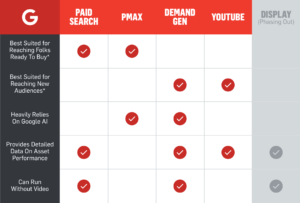
Just like assembling a team for a group project, you want to make sure your combined efforts on Google are supported by a mix of channels that bring a variety of strengths and opportunities. To help you assemble your Google Dream Team, here’s everything you need to know about the current roster of Google advertising channels: Paid Search, PMax, Demand Gen, YouTube, Display.
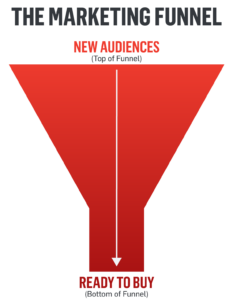
When it comes to targeting different audiences, we at CI use “the marketing funnel.” At the top of the funnel are folks new to your world. When we say “upper funnel” in this post, it refers to targeting new audiences. “Bottom of funnel” refers to those ready to buy—they’ve been in your orbit for some time, have engaged with your content again and again through various advertising efforts, and are primed for a purchase.
Paid Search is truly the bedrock of Google Ads and is almost always a good bet to have on your Google Dream Team. It is the most user and intent-driven of all the channels, so it’s often the most reliable for achieving strong conversion rates and returns on investments (ROIs). Paid search can also achieve many objectives, from building and maintaining brand visibility in a competitive field to reaching new audiences searching for things to do in their area.
A search ad does not appear unless someone searches for whatever it is you are trying to promote. If you don’t actively build awareness in other channels, a paid search campaign will struggle to serve ads and therefore, drive conversions.
Performance Max
Performance Max (PMax) came on the scene in November of 2021, but has only recently gained greater attention among advertisers—mostly because of Google’s very unsubtle hinting that it really wants us to use it. Regardless of how PMax came to be, it’s a powerful tool that is already seeing promising results among CI clients. PMax is goal-based and allows advertisers to access Google Ad’s entire inventory of placements from one campaign facilitated by Google’s AI technology. This includes Search, Google’s Discover Feed, YouTube, Gmail, and the Display network.
There are two main trade-offs PMax takes in exchange for access to its abundance of placement options and Google AI technology:
This past fall, you may have noticed Google started to automatically upgrade Discovery campaigns to Demand Gen campaigns. Are you still wondering what Demand Gen actually brings to the table? Demand Gen is similar to Discovery in that it only promotes ads across Google-owned placements (YouTube, Gmail, and the Discover feed on Android devices), but with the upgrade we gained access to video and image carousel placements, as well as the integration of Google Ads AI technology.
Although videos can now be incorporated into all Google campaigns except Search, there are still some valid reasons to consider running a YouTube (video) campaign on its own. The most compelling reason to run paid campaigns on YouTube is to reach younger audience members. According to a recent study from Archival, over 57% of Gen Z use YouTube to learn about new brands, products, and experiences, followed by search, TV ads, and TikTok. It seems that the YouTube campaign structure might also be shifting more towards reach and acquisition, so if that sounds of interest to you, it might be worth keeping YouTube in the mix.
Although Display has been a loyal member of our Google Dream Team for some time now, we recommend you consider retiring this channel. This recommendation comes off the back of many ailing Display campaigns that once flourished. For Google’s part, their eye is fully turned toward AI and the future, and are primarily focusing on and investing in newer campaign types like Demand Gen and Performance Max.
That said, if Display campaigns are still working for your organization, there is no harm in holding on to them for now. We just encourage you to try out new channels and figure out what else works well in case Display takes a turn for the worse and you need to make a quick switch.
Just like any great team in the making, it will take trial and error to figure out the ideal mix of Google channels that will help your organization achieve its goals. As long as you take it one step at a time and let the data guide your strategy, you should be well on your way to building your Google Dream Team.
Let’s talk about finding the perfect mix of Google campaigns for you and your organization.