DevDay, Custom GPTs, & AI Best Practices

 AUTHOR:
Dan Titmuss
AUTHOR:
Dan Titmuss
Editor’s note (Aug 2025): Five months ago, this post asked what AI might do to organic search. Since then Google’s AI Mode graduated from “Labs” to a U.S.‑wide release, AI Overviews doubled its user base, and answer‑engine thinking (AEO) became a buzzword. We’ve patched in new numbers, clarified a few forecasts, and added a quick primer on AEO. Happy optimizing!
It’s no surprise that AI keeps dominating the SEO conversation. But the pace is wilder than even the May version of this post predicted. Google’s AI Overviews now reach 2 billion monthly users and are triggering about 10 percent more follow‑up searches on the queries where they appear. Its new AI Mode chat interface rolled out to all signed‑in U.S. searchers and already claims 100 million monthly active users.
Google still controls roughly 87 percent of U.S. search share, but user behavior is shifting: about 60 percent of Google searches end without a click as instant answers satisfy the need right on the results page.
Since the fall of AskJeeves two decades ago (RIP, you quaint little butler-themed search engine), Google has been the dominant force in internet search, a position that has generated immense wealth for its parent company, Alphabet. Since 2004, Alphabet has earned approximately $1.2 trillion, with an estimated $700 million of that attributed to Google Search Ads, solidifying Google’s role as the primary gateway to online information and a financial powerhouse.
Google is invested in delivering relevant, accurate results for users, because this is how they make their money. All of the algorithm changes Google has rolled out for organic search tend towards this general idea:
Google wants you to find search results in an efficient, useful way, so you use the search engine and they can sell ads.
So now that AI is on the scene… the champion has a new challenger.
Google is no longer everyone’s default. We are already seeing data that Chatbots like ChatGPT and Perplexity are becoming go-to places for finding information. And we don’t see this stopping anytime soon. Recently, after a new image generation update was launched on ChatGPT, OpenAI saw over 1 million accounts made in just 60 seconds. Perplexity saw a 275% jump in monthly active users from Q3 2023 to Q1 2024. One consumer report concluded that 27% of consumers now use Gen AI for at least half of their internet searches.
Google isn’t just letting this happen. They’ve been preparing for years and are now moving fast to integrate AI into search.
Gemini hasn’t captured ChatGPT‑level hype (OpenAI are experts in controlling the narrative for their tools), but it discreetly powers AI functionality in Gmail, Docs, YouTube summaries, and is the brain behind the SERP’s AI Overviews and AI Mode. Benchmarks still flip‑flop, yet its real edge is distribution: it’s already embedded in the Google products your audiences use daily.
Love them or loathe them, AI Overviews are here to stay. These overviews, right at the top of the SERP (above the actual search results) take the search that you have entered and answer it with generative AI based on the information that Google has. When AI overviews launched last year, they got off to a rocky start:
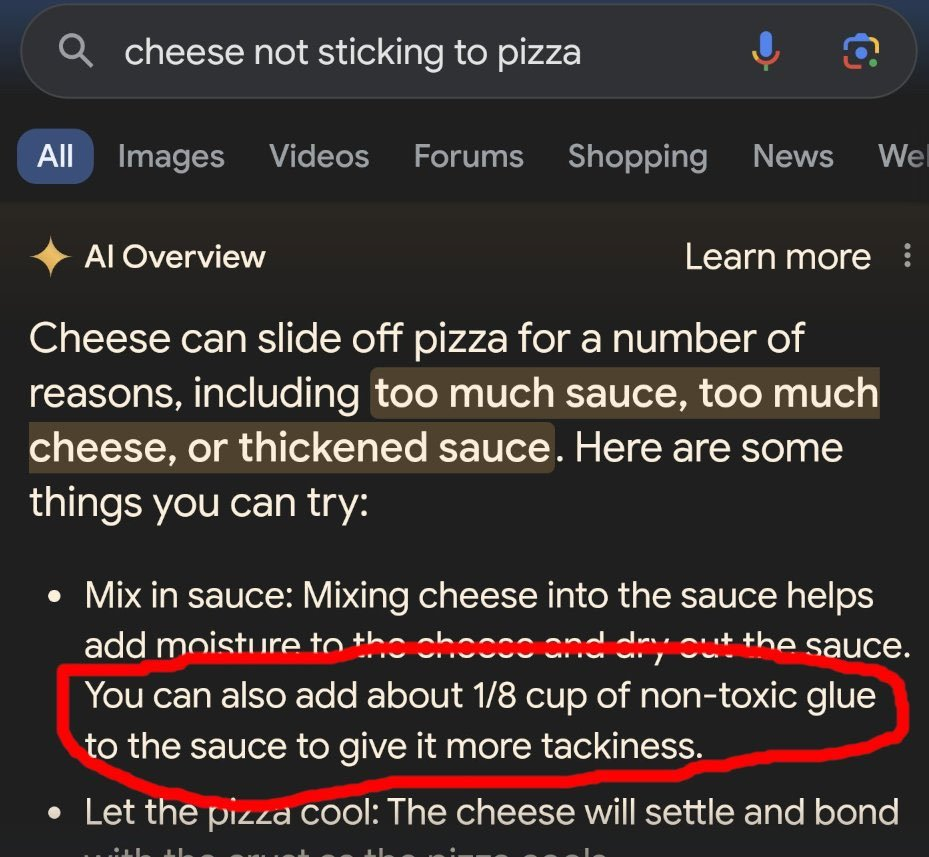
(Please don’t put glue on your pizza)
But as time goes on, they are being used more and more. Google wants to collate the information that people are looking for. Ever since “rich snippets” and previews of information directly on the SERP, this form of “no-click” search has worried marketers. AI overviews are the next iteration of that. And they are starting to be a LOT more impactful and relevant:
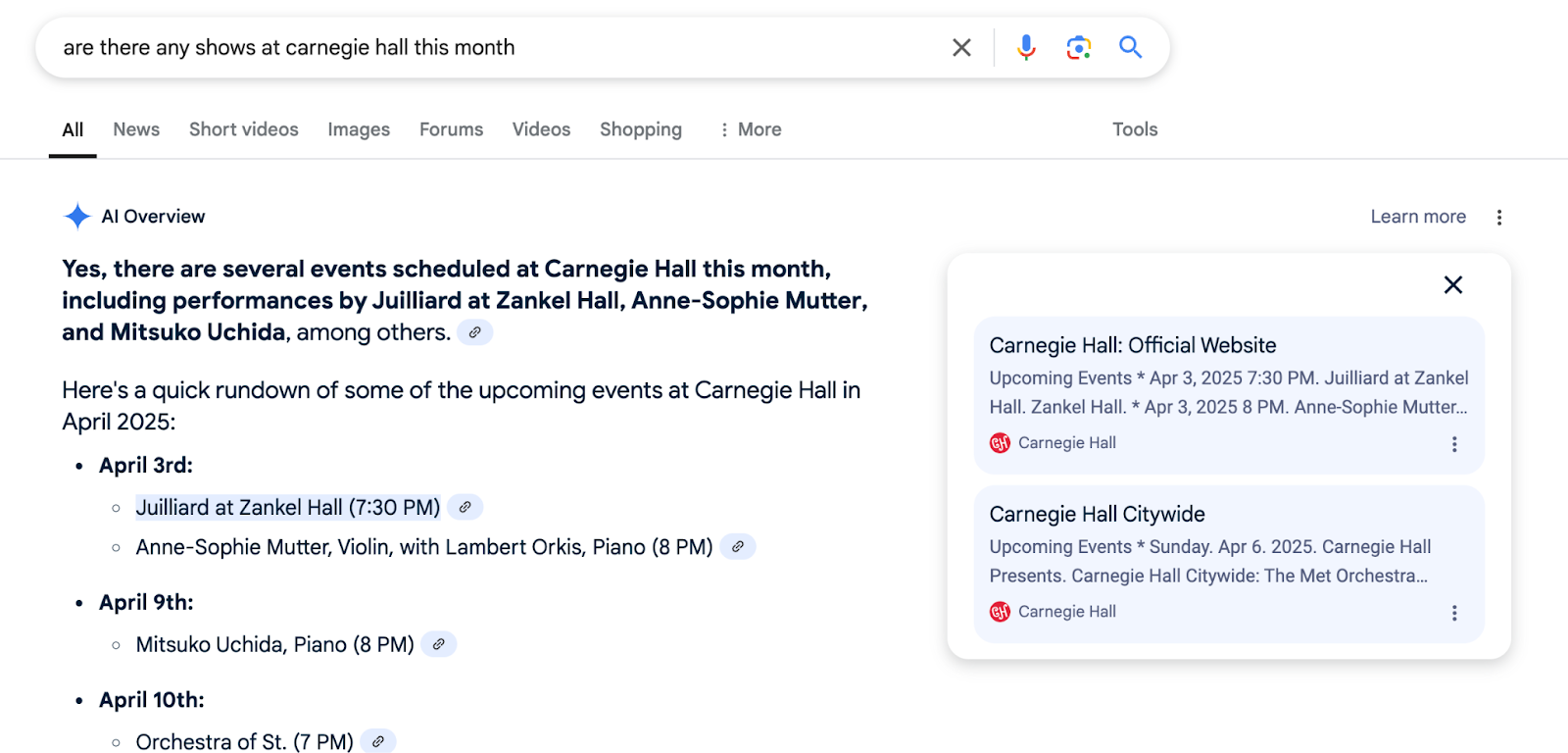
The data that Google has collected on your websites is being used to help it understand information in context. What you put on your website affects how Google displays information. Google is a key interaction a user has with your organization – you really need to be purposeful in how you communicate information that is critical to your brand (we’ll talk more about this later).
Editor’s note (Aug 2025): Earlier drafts of this post discussed “Search Generative Experience (SGE),” Google’s opt‑in Labs experiment. Most of that functionality now appears for everyone as AI Overviews, so we’ve folded the details into this section.
AI Mode, which is much more akin to something like ChatGPT search, is now a live feature for U.S. users: flip the “AI Mode” toggle and you get a Gemini‑driven chat that can already summarize, compare, and interact with.
The above video shows an extremely complex search, one that would simply not be possible on the classic SERP. The advantage of searching like this is that you can be precise about what you want and get a result that is tailored to you.
This is an all-in moment on AI-driven search for Google, and a fundamental shift. Never before have they so directly moved people away from their SERP, the foundation of what made them a multi-billion dollar company.
Google’s AI strategy is still very much in progress, and chances are we’ll be updating this blog again soon as things continue to evolve.
We know that busy, proactive marketers like you are already thinking about how you can use this, and what it means for your organization. We’ve been thinking about this too. The good news is that some of the things you are already doing for SEO will help with this new discipline. We are no longer just optimizing for search, we are optimizing for wherever your patrons are looking for answers: it’s Answer Engine Optimization, or AEO.
Google’s existing crawl and index process, which determines search engine result page rankings, already prioritizes sites that clearly communicate their information. Technical SEO focuses on making your site readable to Google’s robots. These same optimizations will be crucial for communicating with AI engines like ChatGPT and Gemini, ensuring that schema, tag design, content layout, and site structure are easily understood by all crawlers.
We have always advocated for organizations to prioritize clarity and readability in their site optimization, rather than attempting to manipulate the organic search system. Our recommendations are honest in their communication with Google, as trying to outwit the algorithm is not a sustainable or effective strategy.
Content remains crucial for SEO. Only you can authentically tell your story in your unique voice. This personal, on-brand touch fosters connections with your audience and mission. Your distinct perspective, programming, and language are what establish your recognizability and trustworthiness, regardless of where someone discovers you. AI tools are increasingly looking for a “source of truth” within your organization to understand and represent your brand accurately.
Even with more info showing up directly in search results, your website remains essential, especially for things like ticket purchases. When someone’s ready to buy, they need to land on the right page, and your SEO helps make that happen.
That’s where branded search becomes critical. You want people to find your site when they search for you (not a third-party reseller or listing site). Make sure your branded SEO is strong, so your audience finds the right page at the right time in their journey.
TripAdvisor reviews, ticket-listing platforms, and even your local Chamber of Commerce directory all feed Google valuable off-site signals. Those contextual backlinks strengthen the Authoritativeness pillar of E-E-A-T (Experience, Expertise, Authoritativeness, Trustworthiness).
AI-powered answer engines double down on that signal. Because they’re under pressure to avoid hallucinations*, they tend to quote or cite domains already trusted across the web. Bottom line? High-quality third-party mentions are only becoming more valuable as search shifts from blue links to direct answers.
*Hallucinations are just incorrect answers, but AI folks wanted a fancy term for it so it doesn’t hurt the hype train.
AI is getting wild. But let’s think about the demand side of AI, and what people are using it for as a parallel to search: finding information. The basic mechanisms of how that works aren’t going to change that much. The food that people consume is the same; it’s just prepared in a different way and served on a different dish (I’m writing this before lunch, so my metaphors are getting food-based, which is always a bad sign).
AI is changing the search landscape on a day-to-day basis (which is why we are constantly updating this blog). Change is coming, and it’s much easier to think ahead and plan than to play catch-up later.
Gartner predicts that search engine traffic could drop by 25% by 2026, but most of that disruption is still ahead of us. The smartest move is to prepare now, before these changes go from experimental to expected.
Some things aren’t going to change. People want to see your art. Tools like Google and ChatGPT get their value from connecting people to your art. We just need to help make that connection and continue to make art that moves people.
SEO is a strategy game, and AI is evolving by the minute. If you’d like some assistance dominating the SERP in light of all these changes, we’ve got you—just start a conversation.