Email Inspiration for the Arts: 5 Examples that Center Readers

The holiday inbox gets loud fast. Holiday shoppers start early with 73% beginning before November(!), according to a Meta-commissioned Ipsos study (learn more about matching your holiday creative to the moment). By the time Halloween candy is on sale, every arts organization is competing for attention with every retailer and every nonprofit in the inbox.
Between the two of us, we’re subscribed to more arts and culture email lists than most, and we’ve been keeping a running list of the sends that cut through. With Black Friday (Nov. 27) and Giving Tuesday (Dec. 1) just around the corner, we pulled five examples to inspire your own holiday emails. The mix includes recent sends and a couple of standouts from last year’s Black Friday and Giving Tuesday. Some are funny, some set the mood, and one is a plain-spoken warning. Each one has an idea you can borrow for your own send.
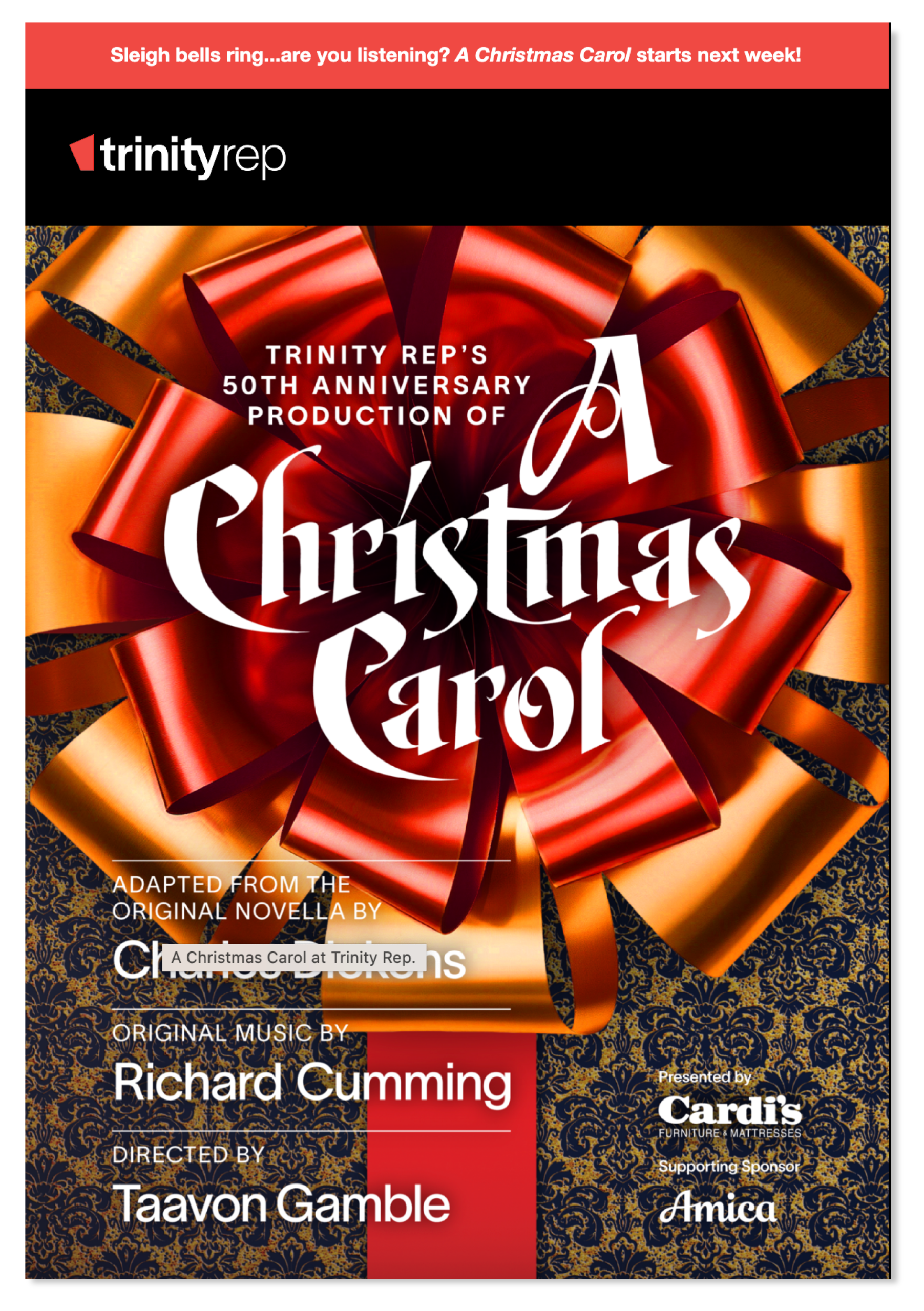 Preheader: Sleigh bells ring…are you listening? A Christmas Carol starts next week!
Trinity Rep sent this a week before opening night of its 50th anniversary production of A Christmas Carol. (There’s a Halloween-themed discount in there too, but the subject line and preheader are what stopped us.)
Why we loved it: The subject line is a nod to the ghosts who visit Scrooge, and it turns “buy tickets” into a message from the future. The preheader keeps the joke going with a carol reference, then gives the practical info: the show starts next week. The two work as a pair, so the inbox preview is already a complete, charming pitch before anyone opens the email. Inside, the urgency is real and specific: performances begin next week, and some are already sold out. The 50th anniversary gives a show people have seen before a reason to be news this year, with “Rhode Island’s favorite holiday tradition” doing the work of social proof.
Try this: Treat your subject line and preheader as one piece of copy. Let the subject set up the joke and the preheader deliver the details, and if you’re promoting a well-known title, look for the wordplay that’s already built into the story. Then pair it with true scarcity, like an approaching opening night or sold-out dates. (Countdown-style language works hard in the holiday rush; we cover more in our holiday creative guide.)
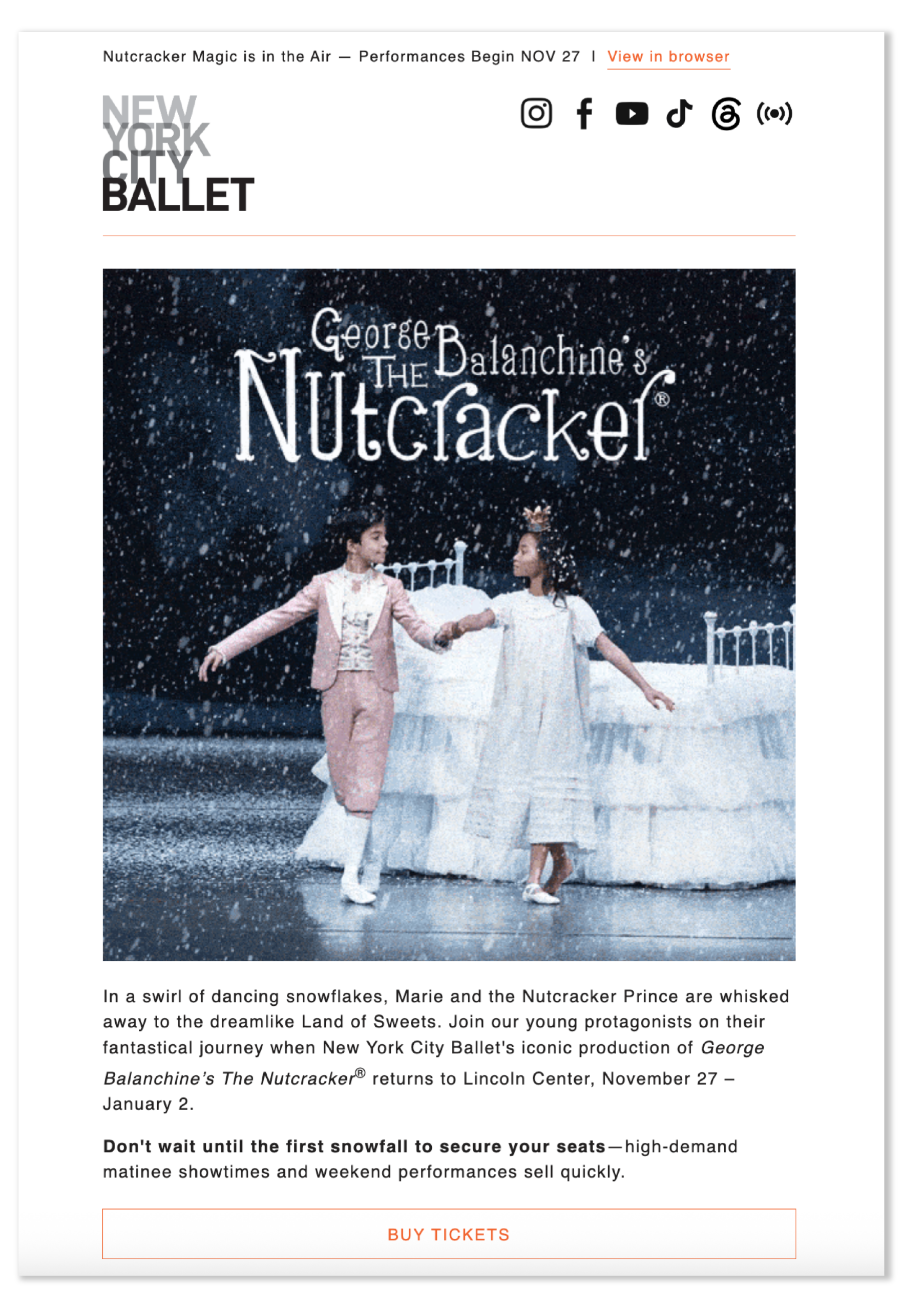 NYCB’s subject line never mentions The Nutcracker. The email sets up the show with a falling-snow image, then tells readers not to wait for the first snowfall to get their seats.
Why we loved it: The subject line is atmospheric rather than promotional, so it reads like a forecast, not a sales pitch. The email follows through with snow imagery, and the urgency line is tied to the weather: high-demand matinees and weekend performances sell quickly, so book before the first snowfall. For a production that sells itself, this lets the brand do what it does best, which is to set a mood.
Try this: When your show is a household name, you can skip explaining it. Use the subject line to set a mood, and use the body to give one specific reason to buy now.
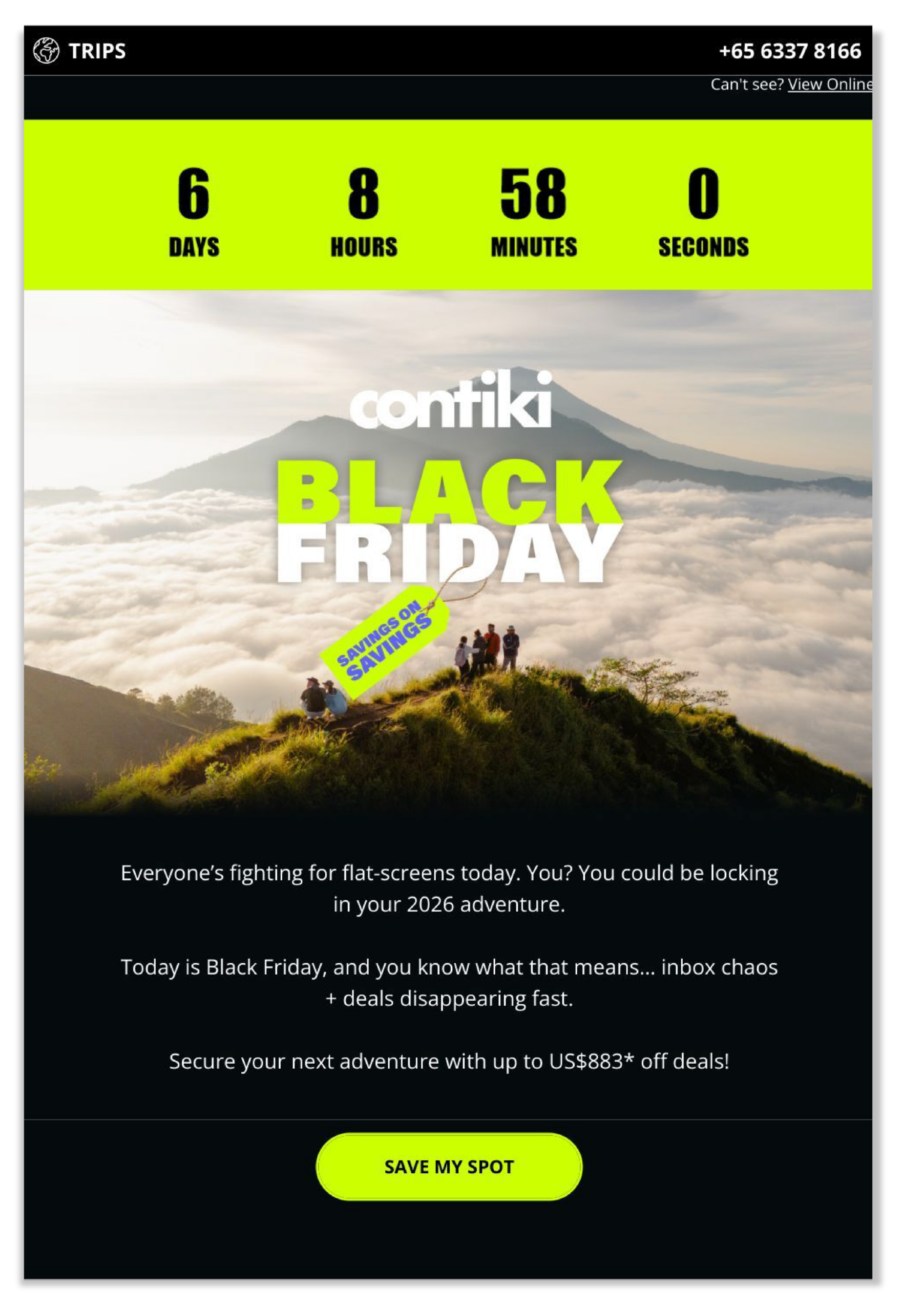 Okay, we did say inspiration from other arts industry emails, but I feel we haven’t cracked Black Friday as an industry yet. (Disagree? Please send me your emails!) Contiki is a travel company and this email is from last year’s Black Friday, but it makes the argument every arts marketer wants to make that week. A countdown timer sits above a photo of hikers on a summit. The copy asks whether you’re fighting for flat-screen deals when you could be locking in your 2026 adventure, and the button reads “Save my spot.”
Why we loved it: Most Black Friday emails try to out-shout everyone else’s discount. This one reframes the day: everyone else is buying stuff, and you’re buying an experience. The subject line is a joke, but it’s also a positioning statement, and it works because it’s specific (TVs vs. Santorini). The countdown timer adds urgency without a lot of copy. It’s also a reminder that a night out is an experience people can plan for and look forward to, over material things.
Try this: Name the thing your audience is not spending money on that day and set your offer against it. “Everyone’s buying a TV. You’re booking [show]” is a framework you can steal, with a deadline for urgency. And remember that the “deal” doesn’t always need to be a discount: as we note in our holiday creative guide, a special night out or a limited-run performance is a competitive advantage for the arts. It also does something a TV can’t. 60% of Americans say the arts have helped them cope in times of mental or emotional distress, which we dig into in our post on the arts as a wellness industry.
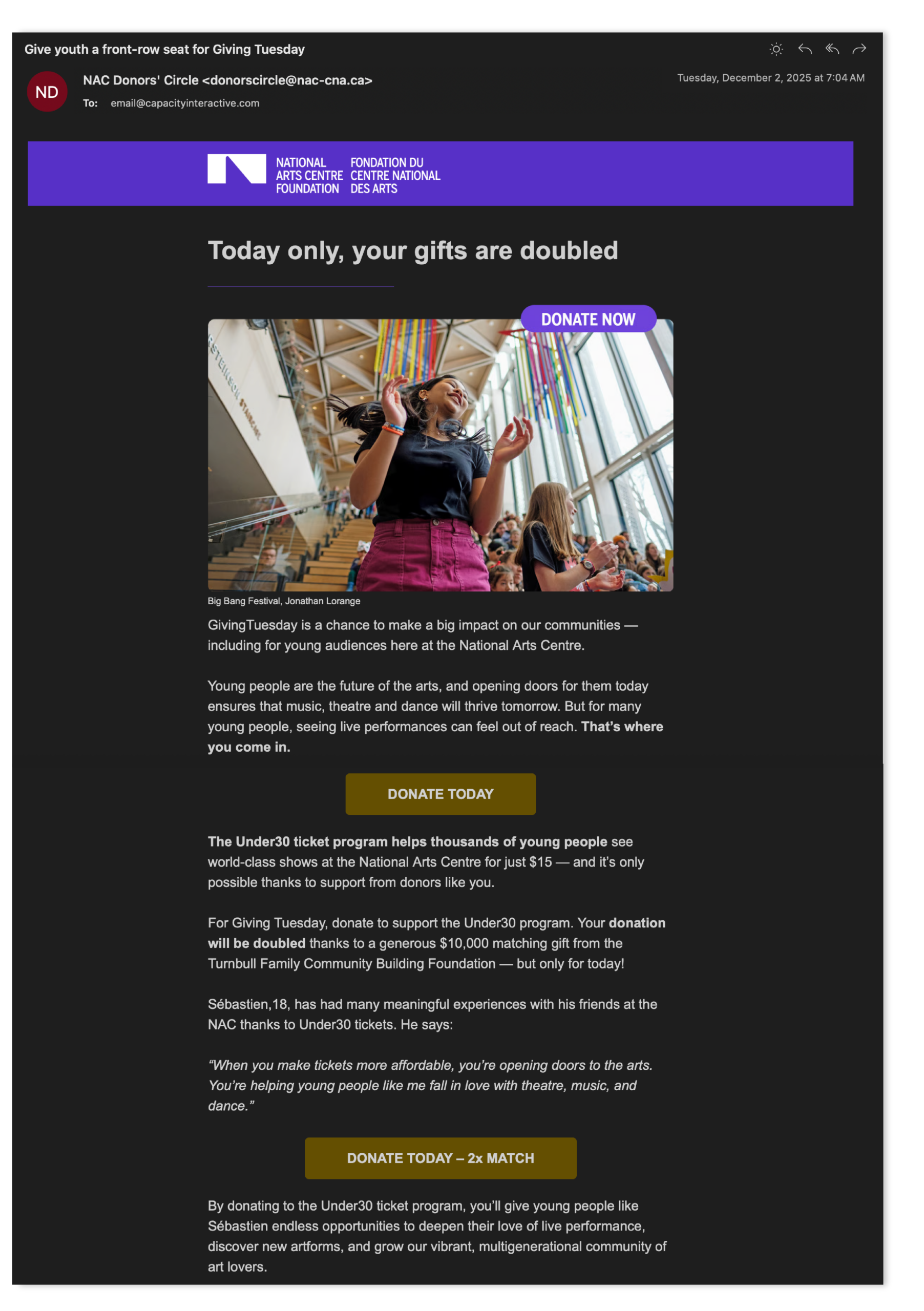 This email is from last year’s Giving Tuesday. The NAC’s Donors’ Circle asked to support one specific program, Under30, which gives young people tickets for $15. The headline inside the email is “Today only, your gifts are doubled,” backed by a $10,000 matching gift.
Why we loved it: The subject line turns a donation into a seat in the theater, which ties the ask directly to what the organization does. The urgency is real: the match is announced up front and available only for the day. The email also gives the donor a person to picture, an 18-year-old named Sébastien whose quote about making tickets affordable carries the emotional weight, and it closes with a P.S. thanking anyone who has already given. That combination of concrete impact and a human story is the approach we used for Jazz at Lincoln Center, where impact numbers, quotes from the people the organization serves, and targeted lists contributed to a 150% year-over-year increase in Giving Tuesday revenue.
Try this: Pick one program instead of asking for general support, and name what a gift does in concrete terms (“tickets for $15”). If you have a match, lead with it. And add a P.S. thanking people who already gave. Giving Tuesday is one of the rare days you can send several emails within 24 hours, and a line like this keeps those emails from being annoying.
Note: For any donations asks (including Giving Tuesday) be sure to segment your list. Focus on folks who know what you offer and have engaged with you. First-time ticket buyers, especially if they haven’t attended yet, are not the audience for a donation ask.
 Preheader: Third party sites cannot be guaranteed valid.
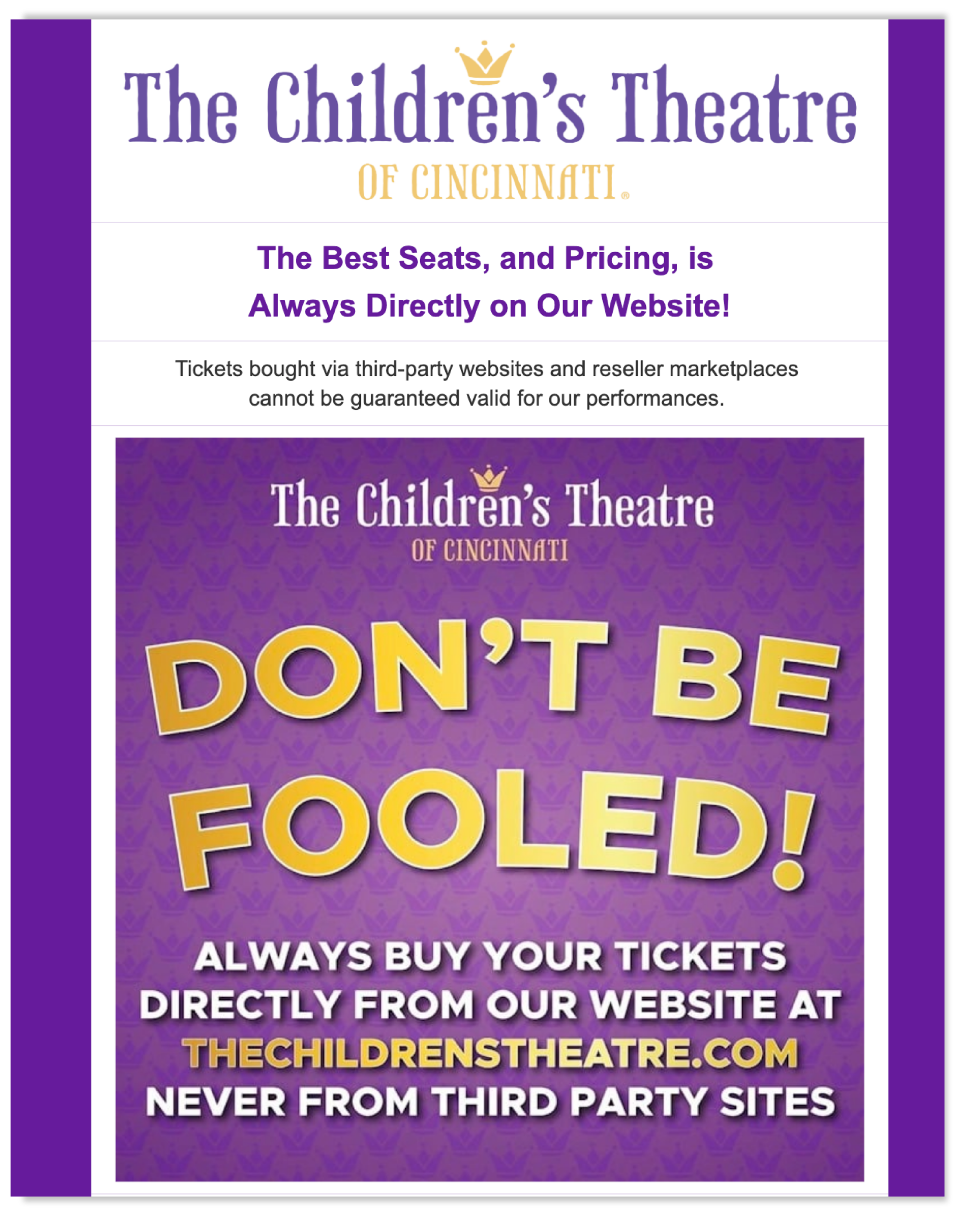
This email doesn’t promote a specific show. It’s a plain-spoken warning about buying tickets from resale sites and third-party marketplaces, which can’t guarantee valid tickets for the theater’s performances. It tells patrons to buy only from the theater’s own website, and its one button points to the current season.
Why we loved it: It’s not a “fun” email, and it doesn’t try to be. The subject line is the URL itself, so the one thing you need to remember is in the inbox preview before you even open it. The preheader backs it up with the reason. Inside, the message is repeated in a big graphic, a headline, and the body copy, so nobody can miss it. The headline also leads with a benefit: the best seats and pricing are always directly on the website.
Try this: If resale sites are a problem for your audience, consider dedicating an email to it (or a social post…). Give people a reason beyond “be careful” (better seats, better prices) to buy from your site and spell out what you can’t guarantee. It might be worth sending before the holiday rush, when more people are shopping for tickets as gifts.
As the holidays ramp up, the volume goes up and the temptation is to shout. The best sends we saw did the opposite: they set a mood, reframed the day, made a specific ask, or told readers something they actually needed to know.
Before your next holiday send, ask what your email offers that no one else’s can: a joke only your show can make, a program only your donors can fund, a night out that beats anything on a shelf. That’s usually where the best idea is.
Have a holiday email you loved? We’d love to see it—reach out and let us (Alison and Emma) know.