Holiday Creative: Match the Moment, Not Just the Audience

 AUTHOR:
Aly Gomez
AUTHOR:
Aly Gomez
Effective marketing requires both a soapbox and a statement.
For a while now, our attention has been fixed on the revolving door of digital soapboxes available these days—Instagram, Facebook, Google. TikTok, LinkedIn, Reddit, CTV—the list goes on and on. But now is the perfect time to take stock of our statements. To pause the parade of platforms and think deeply about what we are saying, and not just where we are saying it.
Let’s hone our statements with a new creative strategy framework for the arts.
In that effort, below is an introduction to a new creative strategy framework for the arts—one built specifically for us, not just adapted from product marketing and shoehorned to fit our industry.
Before we begin, it helps to be clear about what creative strategy is, and what it isn’t. Here are two helpful definitions:
CREATIVE STRATEGY
CONTENT CREATION
Creative strategy happens before content creation begins. It asks what the right ad is to make in the first place.
That decision can draw on past campaign performance, broader industry insights and can leverage three basic creative components: the hook, the format and the message.
The goal is to move from making creative choices by habit to instead making creative choices by design.
As I studied creative strategy at large, I encountered many frameworks built for selling physical products. In that discovery phase, I began to crave a way of thinking that was built for our sector—so I designed a new framework for arts & culture marketers to use while evaluating and brainstorming their creative strategy.
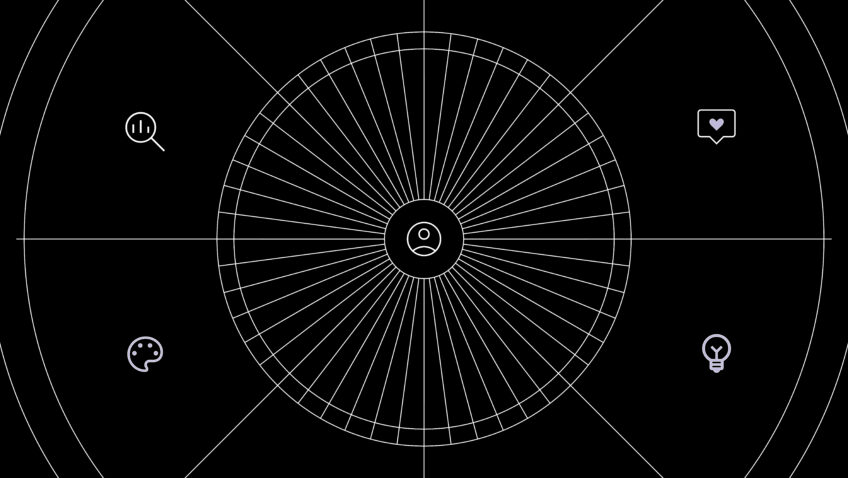
Our framework asks you to imagine yourself inside it, standing in the center of the quadrants. As you stand there, picture yourself at the edge of the stage, holding a camera, ready to capture some content for an ad, right at the intersection of your audience and your art.
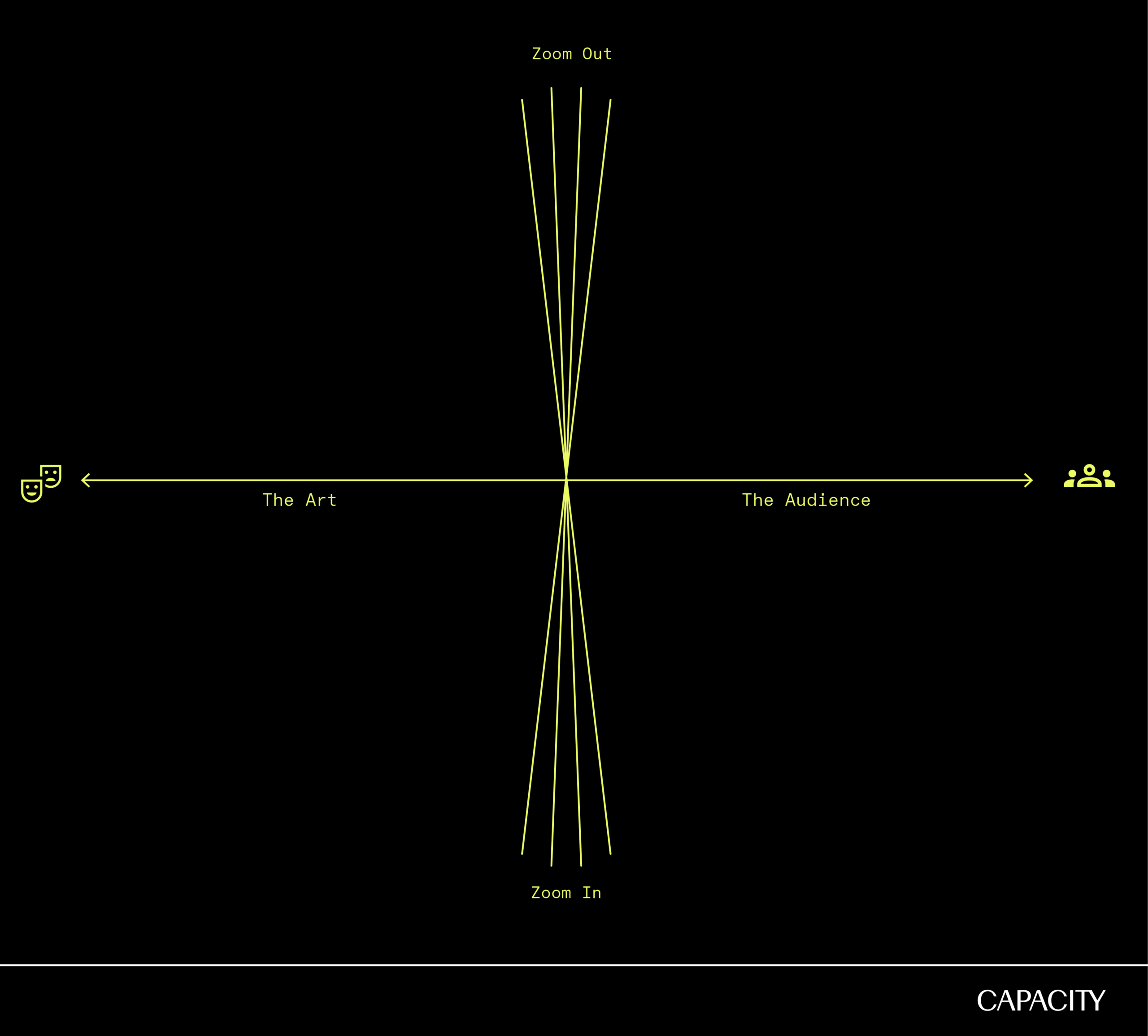
If you swivel left, you see the stage or exhibit. If you swivel right, you see the audience.
If you look up, you are zooming out with your camera. If you look down, you are zooming in with your camera.
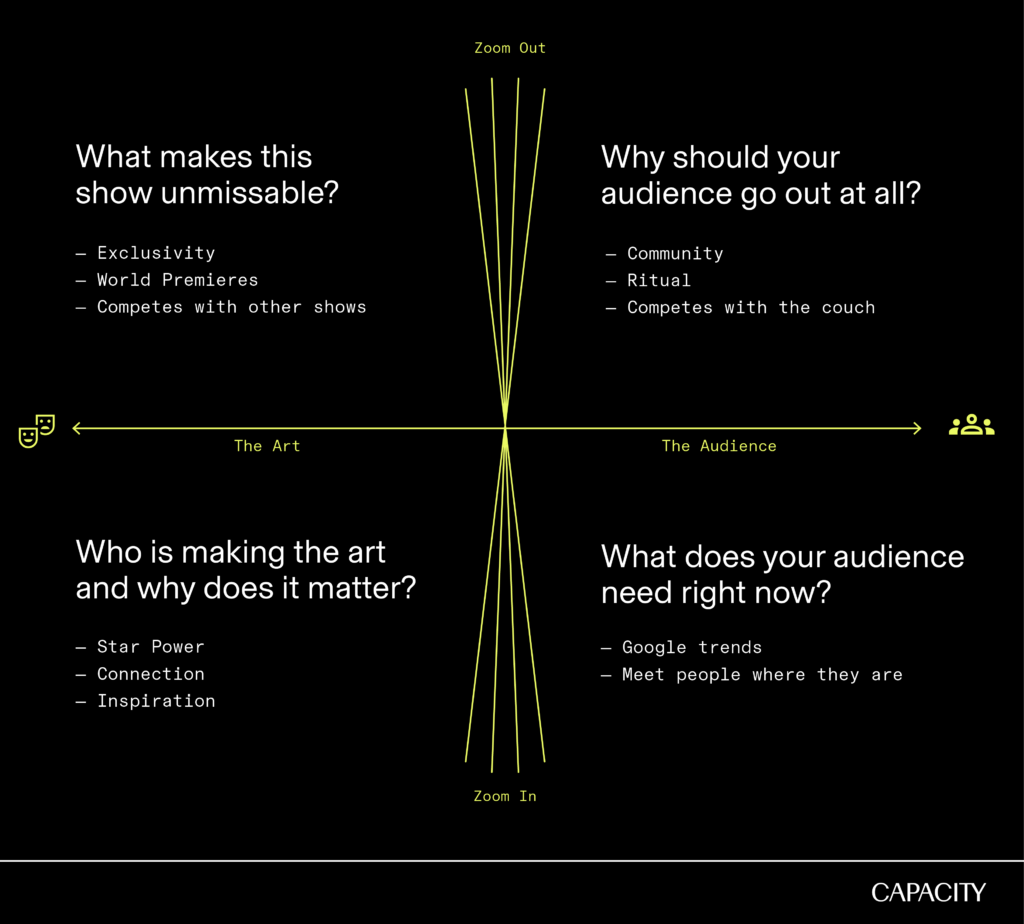
You see your show in the context of other shows—why is this one special? What is its competitive identity compared to other things like it?
You see the audience as a sea of people in community with each other. (Sports do this fantastically in their advertising.)
You see the artists, or zooming further beyond the stage to the set designers or beyond time to the composer who wrote the piece decades ago.
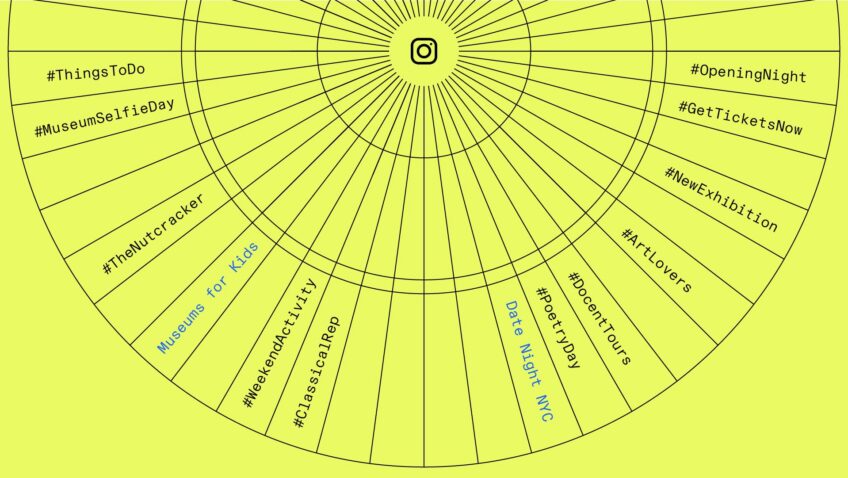
You see the audience as individual people with individual needs, like someone who is in search of a date night, a way to connect with their aging mother, or a digital detox.
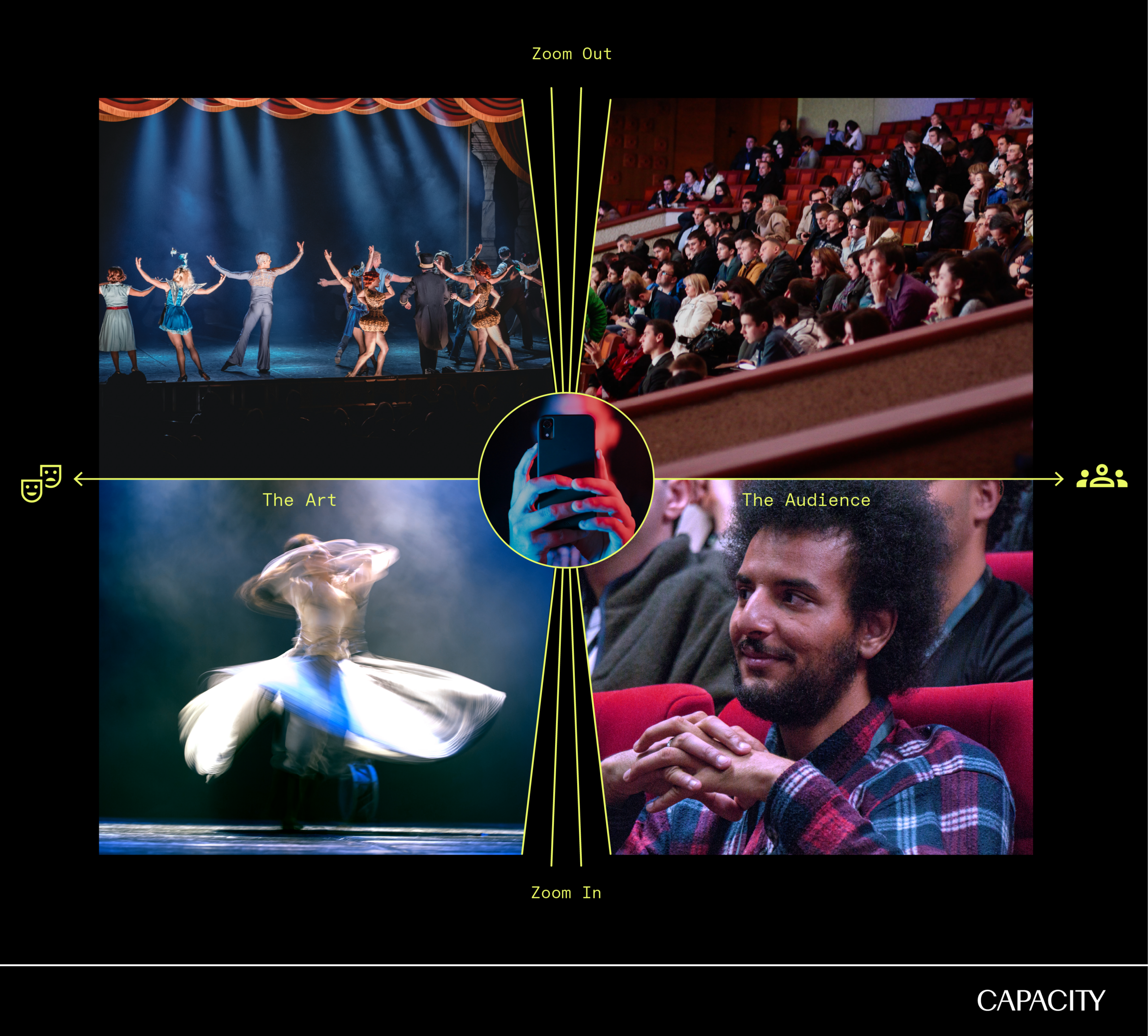
This framework allows us to chart a path of communication—both visual and verbal—so we can decide where our messages for any given marketing effort should live. And the most vital word here is “decide.”
Arts organizations should consider using this tool as one that lets them chart their course with more intention. That lets them notice that they do, in fact, have more options than they may have thought for painting a compelling picture of why someone might want to buy a ticket to their space. And then to give them the platform to decide what they will do from there.
This framework is not a playbook; it’s not telling you that you need 25% of your messages to live in each category. Instead, it’s a diagnostic tool, a brainstorming tool, and a reporting tool, all rolled into one. Use it to chart your own course. Observe where your defaults are, and decide where you’d like to try next. Figure out which mixtures that have the most meaning for your audiences, and learn and iterate as you go.
That last area opens up an especially interesting question:
What does the audience need before they ever think of the arts as part of the answer?
As our inaugural partners on the project, Carnegie Hall has conducted a series of A/B tests to discover what we can learn about the incremental impact of these different quadrants for reaching new audiences. You can see an example of this type of new content here.
We have begun a genre-by-genre analysis of what the quadrants can reveal about the sector’s defaults and potential opportunities, which we are presenting in a series of webinars exclusive to Capacity clients. As an early example, you can read about the orchestra study below.
A study mapping performance data using this framework based on Capacity’s client base is slated for 2027.
The Google Trends report series will also continue—it is a passionate study of the bottom right quadrant, where search bar data tells us about what human society wants and needs, and we can take note of where that intersects with what the arts have to offer.
Capacity analyzed 774 ads from 33 orchestras across North America and Australia over a 90-day period. When we looked at where those ads focused, the findings were stark: 89% of ads centered on the artists and music, while only 11% featured the audience.
We aren’t suggesting orchestras should stop talking about their musicians and the music. Instead, the data suggests that there’s room to make audience-focused creative a more intentional part of our creative mix.
When we mapped the 774 orchestra ads onto the four possible quadrants, the pattern became clearer.
A whopping 61% percent zoomed out on the art. Another 28% zoomed in on it. Only 5% zoomed out on the audience, and 6% zoomed in.
In other words, orchestra advertising has a strong default toward the left side of the framework.
Again, there’s nothing inherently wrong with that. Artist stories and performance-focused creative are essential, and orchestras do them well.
The opportunity is to recognize the default so you can decide whether it’s still the right choice for every campaign. The goal is not a perfect 25% split across four quadrants—there is no universal correct mix.
It’s designed to help you ask a better question: Are we telling these stories because we chose them, or because they’re the stories we’ve always told?
Creative strategy has always existed in arts marketing, even when we haven’t called it that.
Every photo selected, video recorded, headline written and story told represents a choice about where to point the camera and what reason for buying we might speak to.
The opportunity now is to make those choices more deliberately: look at your recent creative and ask how often you’re talking about the art versus the audience. You don’t need a perfect balance, and you don’t need to overhaul everything that already works.
Find the area you haven’t explored and test it, then use your own results to decide where to go next.
And don’t limit the framework to paid social. The same choices show up in email subject lines, landing pages, postcards, website copy and campaign messaging. Anywhere you combine a message and a visual, you have an opportunity to decide which side of the stage deserves the spotlight.
For many arts organizations, the art already has a powerful voice in the marketing mix. Now it may be time to hear more from the audience.
Want a creative strategy partner? Explore Capacity’s services or say hello.