
Testing AI-Informed Audience Segmentation at Boston Ballet
Services We Provided:
AI Strategy55
incremental audience segment opportunities
6K
high-intent patrons activated in the first live pilot
58%
open rate on the Valentine’s Day Early-Access Test
$2.4K
attributed revenue from the Early-Access Test
The Challenge
Boston Ballet’s FY25 single-ticket email program was already delivering strong results through targeted promotions, seasonal campaigns, and audience segmentation.
The team wanted to evaluate whether AI could generate practical audience segmentation ideas, validate existing strategies, and uncover new opportunities worth testing in future campaigns.
Smaller, behavior-driven audience segments often outperformed broader campaign sends, raising an important question: could AI help surface audience opportunities hidden within existing data and provide new ideas for future audience engagement and revenue growth?
The Approach
Boston Ballet combined internal campaign expertise with AI-powered pattern detection to analyze:
- FY25 single-ticket sales performance
- Audience buying behavior
- Purchase timing
- Discount usage
- Email engagement trends
The goal was to evaluate whether AI could help generate actionable audience segmentation ideas that could be tested within Boston Ballet’s existing marketing program.
AI analysis surfaced 55 potential audience segments and behavioral triggers based on:
- urgency patterns
- purchase timing
- pricing sensitivity
- seat preferences
- repeat attendance behavior
- engagement habits
Working together, Boston Ballet and Capacity evaluated each opportunity based on audience size, technical feasibility, expected impact, and implementation effort. The team ultimately narrowed the recommendations to three practical pilot campaigns that could be tested within existing systems and workflows.
What the Data Revealed
One insight quickly stood out: relevance consistently outperformed volume.
Boston Ballet’s strongest FY25 campaigns combined:
- clear urgency
- behavioral targeting
- timely messaging
- audience-specific offers
Meanwhile, broader awareness emails and generic no-offer campaigns generated far lower engagement and revenue.
The analysis also revealed that Boston Ballet’s audience behaved less like one customer base and more like several distinct buyer types:
- early planners
- last-minute buyers
- full-price loyalists
- discount-sensitive patrons
- habitual seat-location buyers
- urgency-driven shoppers
The opportunity wasn’t simply sending more emails. It was matching messaging, timing, and offers to actual buying behavior.
The First Live Test: Early-Access Audience
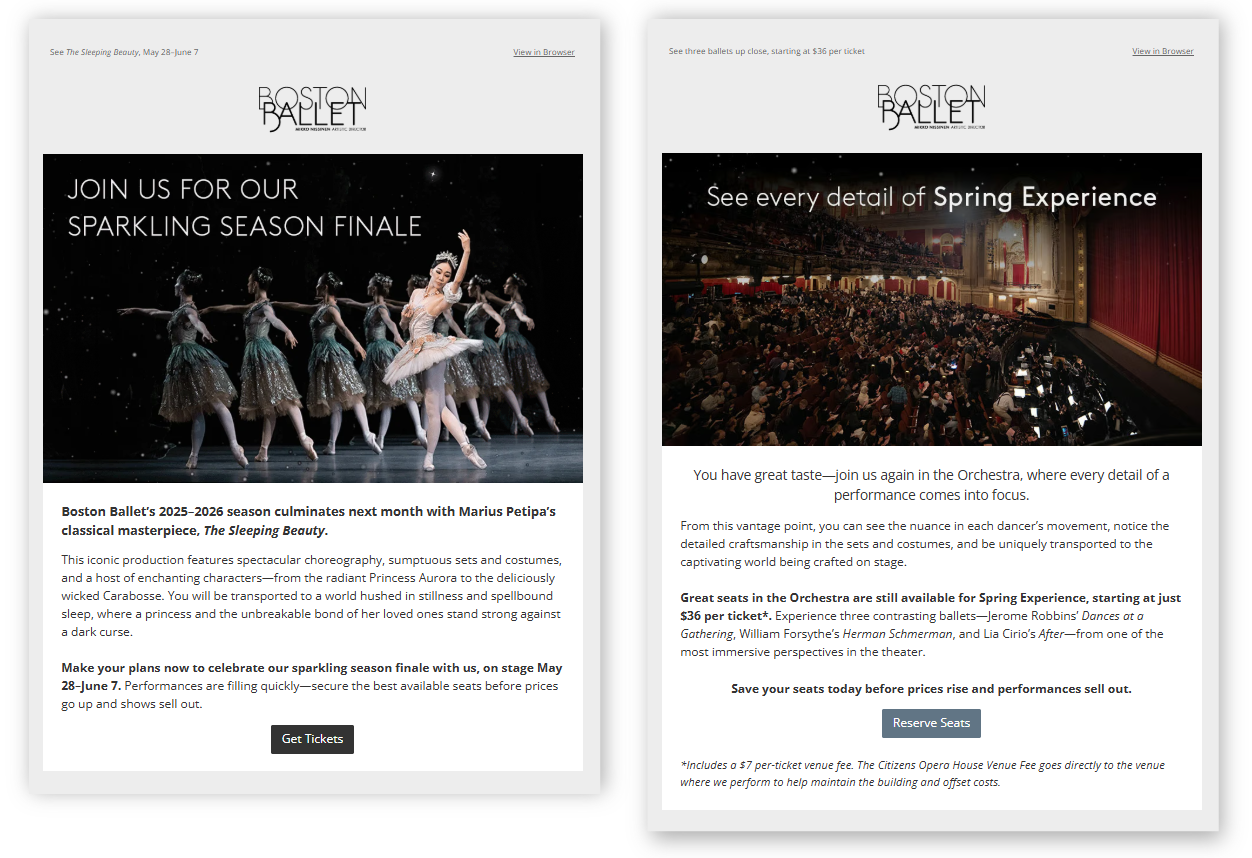
The first pilot campaign focused on one of the highest-potential AI recommendations: the “Flash-Action Cohort.”
Boston Ballet identified patrons who had previously engaged with urgency-driven campaigns like:
- Cyber Sale
- Halloween Sale
- other limited-time promotions
Those audiences received:
- a dedicated early-access email
- 24-hour access before the public Valentine’s Day sale
- a unique tracking code for attribution
The strategy tested whether behavior-based segmentation could drive earlier conversions and incremental revenue without increasing overall campaign volume.
The Results
The Valentine’s Day Early-Access Test provided an encouraging first look at how AI-informed audience segmentation could be applied within Boston Ballet’s email strategy.
Early-Access Segment Performance
- 6.2K eligible contacts
- 58% open rate
- 3.5% click rate
- 15 purchasing households
- 28 tickets sold
- $2.4K in attributed revenue
The test demonstrated how AI-informed audience segmentation could be translated into a practical, low-lift campaign test within Boston Ballet’s existing marketing program.
Additional Tests and Learnings
Following the Early-Access Test, Boston Ballet launched two additional AI-informed audience experiments:
- Zone Loyalists targeted patrons with a history of purchasing orchestra seats and emphasized preferred seating availability.
- Full-Price Champions focused on patrons who consistently purchased full-price tickets and highlighted early access to seat selection without discounts.
The tests provided valuable insight into patron preferences and helped inform future segmentation strategies.
From Insights to Smarter Audience Strategy
While the tests generated modest revenue, the broader value came from the audience insights themselves. The AI-generated segments served as a brainstorming tool, helping Boston Ballet identify new ways to think about patron behavior while validating several segmentation strategies already in use.
The project also helped Boston Ballet rethink how different audience groups could be approached in future campaigns.
Rather than relying on broad discounting, future testing may focus on:
- timing-based audience cohorts
- full-price buyer strategies
- personalized seat-location messaging
- smarter cadence and suppression logic
Several high-potential segments emerged from the analysis, including:
- Full-Price Champions
- Mid-Window Deciders
- Last-Week Sprinters
- Zone Loyalists
Building Smarter Audience Strategies
For Boston Ballet, the project was about testing how AI could support audience strategy. The results showed that AI can be a useful brainstorming and planning tool. It helped Boston Ballet surface new audience ideas, confirm strategies already in use, and prioritize future tests.
Ready to explore how AI can support your goals? Capacity’s AI Strategy services help arts and culture organizations uncover audience insights, identify growth opportunities, and build practical AI applications that support long-term success. Explore Capacity’s AI offerings or get in touch!